NZNO's Blog


3 Comments

A message to nurse managers

A message to nurse managers from NZNO acting professional services manager, Hilary Graham-Smith. Hilary has had a long career as a registered nurse working in primary health care and as a Director of Nursing in primary health care.take a chance on a new grad
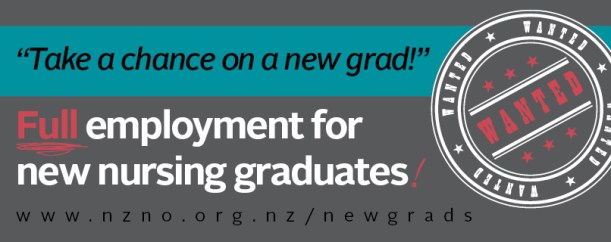
“A sustainable, fully utilised nursing workforce is NZNO’s number one priority.

We also want a sufficiently funded nurse entry to practice (NEtP) programme so that 100 percent of our new graduate RN and ENs are employed and appropriately mentored and supported during their first year of practice.

The current nursing workforce has a vital role to play in that. Sadly, we still have a significant number of new graduates who do not get into NEtP programmes who are looking for work – they need our help.

We know that many of your work environments are stretched by less than adequate staffing and we hear many of you say, “We haven’t got time to preceptor new graduates”. However we all have a role to play as experienced nurses to make sure that our new grads are welcomed into the workforce; our collective experience and expertise will help to grow the nursing workforce of the future.

I encourage those of you who are in decision-making roles and involved in recruitment to stop and think for a moment before deciding NOT to offer a job to a new grad; so many of the responses to Keren MacSween’s story were from new grads who had been turned down because of a lack of experience.

I ask, isn’t that our role? – to make sure they get experience in an environment where they can not only learn from others but share their new knowledge. New grads don’t come without skills they just need time to grow their self-assurance and confidence in clinical practice.

Remember how that felt – being the newbie RN or EN? This is about nurses doing it for nurses and the wellbeing of the whole profession.

So think about it next time a new grad applies for a job in your ward/unit/ department – give them a go. Go on you know you want to!”



3 Comments

The long road to justice at Capital and Coast DHB

leave entitlementCapital and Coast DHB (CCDHB) delegate Erin Kennedy talks about a workplace situation where holding the DHB to account has taken years. The hard work and perseverance of delegates and organisers has finally paid off.

After several years of work by NZNO organisers and delegates at CCDHB, members whose shift leave was not calculated correctly look set to finally get the leave they are due. Staff affected worked alternative rosters (10 and 12 hour shifts). CCDHB has reviewed records of affected staff from 1 January 2007 to 1 January 2013 to determine which staff are owed leave, with ICU used as a pilot group.

Previously, all shift leave was credited based on shift count under clause 13.2 of the MECA. However, clause 6.19 of the MECA, which covers alternative rosters, states that on completion of one year on alternative rosters, employees should receive one week of shift leave in place of the provisions set out in clause 13.2.

While delegates and organisers are pleased that, at least in one directorate, the end is in sight for this project, we still have some concerns. The first is that a number of staff who have left CCDHB have not been able to be contacted.

If you worked alternative shifts at CCDHB during the time covered, please contact CCDHB to ensure you receive any leave due (gary.waghorn@ccdhb.org.nz). If you know someone who has left CCDHB and who may be covered, send this on to them. Although NZNO does not normally support cashing in of leave, on this occasion the cashing in of leave is supported, as staffing in some areas prevents any extra leave being taken.

Our second concern relates to members who may have had leave over-calculated.  Letters set to go out from the DHB ask those staff to sign a form agreeing to pay back any overpayment, either in a lump sum or as salary deductions.  Our view is that the Wages Protection Act kicks in here, and our advice to those staff is not to agree to any repayments without union advice. That advice regarding alleged overpayments also applies to other staff who have recently been asked to repay money which CCDHB claims to have overpaid, including senior nurses on the PDRP. If this applies to you, contact a delegate immediately.

NB: The ICU project which involves correcting miscalculated “adjust to normal” pays is a separate one, which will hopefully soon be concluded and staff paid out.  Again, if you worked at Wellington Hospital’s ICU and think you may have been affected by this, please contact CCDHB.

You can read the multi-employer collective agreement that covers NZNO members and DHBs here (it’s a pdf).


Leave a comment

Succession planning

passing the baton (1)Succession planning is a big part of solving our looming nursing workforce crisis. We already know there are many strands to consider when planning for a sustainable, home-grown and highly skilled nursing workforce.

At the moment we have, at one end of the spectrum, great newly graduated nurses, who are motivated, want to give something back to society but who are unable to find jobs. And for the new grads lucky enough to get a job, some of those positions are not suitable for a new grad unless there are appropriate supports in place, and they shouldn’t be forced to take them. For example, sole charge residential aged care roles, with no support or mentoring/preceptoring available – a pretty scary proposition for a first time RN.

At the other end of the nursing spectrum there are thousands of skilled, experienced nurses who have had long and varied careers who would love to be able to pass their knowledge on to a new graduate, but are not given the opportunity to.

No matter which way you look at it, the nursing workforce is in a quandary!

We need to value our New Zealand educated nursing workforce, and think about succession planning in terms of passing the baton – sharing the knowledge, skills and experience held by the existing workforce with new graduates. It’s just another way we can walk the talk of “growing our own”. (And there’s no doubt that a predominantly home-grown nursing workforce is what we should be aspiring to. But more on that in another blog…)

We need our experienced, skilled older nurses to be prepared to step up as preceptors/mentors; what they know and can share is vital to the development of the workforce.

If it doesn’t happen, where will we be in 2020/2035 when the workforce shortage really bites?

We need a sustainable health workforce plan that supports all our new grads into “nurse entry to practice positions” and at the same time releases our valuable late career nurses from enough of the work at the coal face so they can build the mentoring relationships with younger nurses that will strengthen our workforce and profession.

You can find out more about the issues on our website: www.nzno.org.nz/newgrads


3 Comments

Nelson ED nurses get together to create change

successNZNO members at Nelson Hospital have had their voices heard. They have successfully advocated for quality patient care and a safe environment for staff.

ED staff have been concerned for some time that their work is being compromised by a lack of staff, and all the flow on effects of that situation.

Reportable events about staffing levels had been logged but no action taken. NZNO College of Emergency Nurses guidelines for nurse/ patient ratios were not being met and nursing staff were concerned about the potential for breaches of the Health and Disability Commission code of patient rights.

The ED was experiencing an increased number of high acuity patients and Government targets were not being met. Staff vacancies were not being filled in a timely way and staff were worried that more vacancies were coming up. Annual leave requests were being turned down and staff were becoming more and more stressed and fatigued. They were overworked and overwhelmed.

It’s pretty hard on morale if you work in an emergency department and you don’t have the resources to deal with an emergency!

It’s often difficult to see the wood for the trees when you’re feeling like that, so it is a testament to the courage and wisdom of NZNO members that they made a decision to do something about it, and then followed through.

A meeting with the Director of Nursing and Midwifery and the Nelson Associate Director of Nursing was called and members told their stories one by one. It was a powerful and moving meeting. Staff were honest, passionate and resolute that the situation needed to change. That was 2 weeks ago.

Within 2 days the numbers had been crunched and ED staff were notified that an extra 2.14FTE had been approved and were being advertised. In the interim, casual staff are being used to ease the workload.

It’s a great outcome, and one that only happened because NZNO members worked collectively to address their concerns. When we stand together we are heard.

Ehara taku toa i te toa takitahi. Engari, he toa takitini.

Success is not the work of one, but the work of many.


7 Comments

The personal cost of government failings

woman sillhouette

A new grad nurse talks about what it’s really like to be failed by the system. After not receiving a NETP position after graduating this new grad did volunteer work to keep up her skills. Recently she got a part time position as an “emergency response attendant” at a retirement village.

I am happy to share my story. What I want most out of this is for other people to feel brave enough to speak out. And for the government to come to the party and provide new grad nurses with the job opportunities and Nursing Entry to Practice (NETP) positions that they require.

I suppose my biggest gripe is that I was never ever told throughout my degree that there were limited NETP positions and so, along with my friends, I had the attitude that I would get a NETP position.

The last year of my degree was tailored around paediatrics, where I was totally in my element, working in the area I am so passionate about and the reason I chose nursing as my career.

I am well aware that New Zealand has an experienced nursing shortage… but I feel that the answer to that is to support those new grads who trained in NZ to get NETP positions and then there will be more experienced nurses.

I am no politician, but I’m sure there are better solutions to this situation.

I feel pretty devastated to hear about NZ saying we are short on nurses when there are hundreds just like me.

I know I am lucky to have the job at the retirement village after months of unemployment but I also know it’s not what I trained to do.

I have dreams of working as a registered nurse with children and their families with full support from other nurses and clinical preceptors.

New grads like me are being forced into unsuitable jobs and, although we apparently have a nursing shortage, at each of the six extra interviews I had after my ACE interviews in November, I was unsuccessful due to more experienced nurses applying for the same position.

So while I reapply for ACE and hope and pray that I am successful, I will keep trying to find answers to a situation I now do not understand at all. There really isn’t much to say about it except that it’s unfair on so many levels.

I just hope through my voice I can help other new grads and nursing students because I would never wish for anyone else to experience the amount of disappointment I have in the last six months.


22 Comments

It’s not a skill shortage, it’s a planning deficiency

600px-New_Zealand_on_the_globe_(New_Zealand_centered).svgThe Immigration Department’s “Skill-shortage list” is a list of occupations that are in short supply in New Zealand. The list means that would-be migrants with those particular skills are given preference over migrants whose skills are not on the list. It seems like a great idea and a good way to ensure that New Zealand’s skills needs are met.

Unfortunately, it is sometimes used for the benefit of employers, not the NZ workforce as a whole.

NZNO is constantly responding to consultation requests from Immigration NZ as DHBs and other health providers, especially within the aged care sector, push for nursing and health care assistant roles to be added to the skills shortage list.

Recently, Hawkes Bay DHB, Southern DHB and Capital and Coast DHB have all applied to have registered nurse and midwife positions added to the skills shortage list, and to renew their accredited employer status so they can fast track offshore recruitment of nurses and midwives.

We absolutely reject that the DHBs need to recruit nurses and midwives offshore while there are large numbers of nursing and midwifery graduates still seeking employment.

As a country we need to start addressing the root causes of recruitment and retention difficulties and plan for a sustainable, home grown workforce.

It is not fair that we continue to educate and train nurses and then deny them employment while continuing to recruit offshore. Only 61 percent of last year’s nursing graduates have found placements in nurse entry to practice positions and only half of the country’s DHBs are offering placements in the second advanced choice of employment (ACE) round.

Overseas recruitment processes are long and expensive and often include a six week competence assessment programme. Surely, that time and money would be better spent on supporting new graduates into practice, and facilitating internal appointments with training and education that supports expanded practice and rewarding career pathways for nurses and midwives.

NZNO recognises that demand for nurses is increasing, as New Zealand’s population and the nursing workforce ages, but recruiting from overseas to fill workforce gaps is not the answer.


5 Comments

Growing our advocacy out of the ward

advocacyGuest blogger Erin Kennedy is a senior CCDHB delegate. She has a long history as a union advocate and is passionate about empowering members to work together towards a better working life.

Last week, Radio New Zealand asked to speak to a nurse about what it’s really like working at Auckland DHB in an environment that is understaffed, under resourced and, at times, unsafe.

Not surprisingly, there were no volunteers from Auckland’s current staff.  Most nurses are swift to advocate for patients on immediate clinical matters, but not so forward in publicly speaking out for patients and the health system, fearful that they risk their jobs if they do so.

This is a real worry.  How often have you shuddered at a horror story told in the tearoom, or heard a colleague declare that “I wouldn’t let anyone from my family stay on that ward…it’s just not safe”.  Surely the public has a right to know what is happening in our hospitals.

Dunedin nurses acted together this month to speak out about safety issues in the south. Sadly, nurses all over the country face the same problems – unsafe staffing levels, difficulty taking minimum breaks, problems getting study leave to maintain their PDRP and rosters which do not meet the MECA.  No wonder they feel burnt out and unsupported.

There are many ways nurses can make their voices heard. Speak to your local MP – most are readily contactable, particularly in an election year. Explain to relatives why bells cannot always be answered promptly, or why there is nobody to watch their demented relative and keep them safe. Take five minutes to fill out a reportable event documenting problems. Yes, reportable event forms disappear into a black hole at most hospitals but they still provide essential data when safe staffing and other issues are under the spotlight.

But the most effective voice nurses have is through NZNO – go to meetings, have a voice and keep your delegates and organisers informed about what is happening in your area.