NZNO's Blog


6 Comments

Patients’ rights, nurses’ rights

stress-feature01NZNO delegate, Erin Kennedy asks an important question: “Is unsafe staffing a breach of the Code of Health and Disability Services Consumers’ Rights?”

Like most nurses, I am not easily shockable, but I found myself almost speechless last week on learning that three nurses had been forced into the position of caring for 40 patients overnight on a heavy orthopaedic ward. (A pool nurse also came to help for part of the shift.)

NZNO organisers and delegates have argued strongly for safe staffing for years now, but unfortunately, the level of permanent and pool staffing means that staffing levels including skill mix are often unsafe, with sick staff unable to be replaced. The constant push to avoid financial penalty when the 6-hour Emergency Department rule is breached also leads to patients being moved from the Emergency Department to areas where there are simply not enough nurses to care for all the patients safely.

Under the Code of Health and Disability Services Consumers’ Rights, patients have a number of rights, including the right to co-operation amongst providers to ensure quality and continuity of services, and the right to informed consent. The right to be fully informed means information must be conveyed to the patient in a way that enables the patient to understand the treatment or advice. Right 6 of the code states that every consumer has ‘the right to the information that a reasonable consumer, in that consumer’s circumstances, would expect to receive’. Specifically, it states that patients are entitled to an explanation of his or her condition and an explanation of the options available, including an assessment of the expected risks, side effects, benefits, and costs of each option.

Given the unsafe staffing levels at some of our DHBs, it is high time that explanations around surgery, for example, go further than simply outlining the procedure and its risks and benefits. Patients should ask, and should be told, whether their post operative care will be safe. A “reasonable consumer” clearly has the right to know whether their recovery might be hampered because of unsafe staffing. Certainly, if I have surgery any time soon, I will be asking whether there are enough nurses rostered on to provide all of the care I and other patients require. Will there be enough staff to ensure that I can obtain analgesia or other medications on time? Will the nurses be able to check my vital signs often enough to notice if I am bleeding, or have arrested or need medical intervention? If I need help mobilising to the toilet, will there be someone to help me or will I risk a fall and further injury? Will there be someone to answer my call bell if I need help?

Nurses do not like being forced to ration care, but until all DHBs accept that in many instances staffing levels are unsafe (for both patients and nurses), it is a fact of life and one which can seriously impact patients’ wellbeing and recovery. Not warning patients that their post-operative care may not be optimal, and could be downright dangerous, is, in my opinion a breach of the code.


4 Comments

A demand to be taken seriously

dilbert-ceo-payNZNO delegate Ady Piesse is an activist for fairness at work and an advocate for collective action. This blog post has previously been published as a comment on Facebook. 

I’m a thinker….I think a lot. Sometimes I’m accused of over thinking, but generally my thinking usually provides me with ideas or helps me problem solve.

So, a couple of weeks ago, I got to thinking – what do I do in my job that is so different from my CEO’s that justifies our salaries?

At the start of every shift I check my equipment so if that cardiac arrest, acute SOB, trauma or the blue floppy baby arrives unannounced, I have the confidence that myself and my colleagues will be able to use that equipment to potentially save a life.

My CEO makes sure his lap top ‘on’ button works.

I monitor numerous pieces of equipment attached to my patients, checking for those spiralling trends so I can intervene early if I need to.

My CEO monitors computer screens that check to make sure my patients are meeting the six hour targets.

I do ‘end-of-bed-o-grammes’ all day every day, with new patients, existing patients, other nurses’ patients, to monitor change, deterioration or improvement.

My CEO looks at spread sheets to see how hard I’m working or how much harder I can be made to work.

I hold in my hand medication that has the potential to kill or to cure.

My CEO holds a pen, an iPhone.

I sit holding a patient’s hand while a doctor tells her and her family her condition is terminal. I hold a child’s hand. I hold the hand of a terrified patient who can’t breathe. I hug people I only met today and know won’t be here tomorrow.

I don’t know if my CEO has ever held a hand or given a stranger a hug.

Every day I take home people’s stories; for some it will be the worst day of their lives. These people have faces and I know some will never leave my memory.

My CEO takes home statistics.

Some days I leave wondering if I have it in me to keep doing what I’m doing – less is not more in my job – but my CEO seems to think so.

I know it’s all more complex than that.

I use my knowledge and observation skills to think ahead and intervene early to avoid a failure to rescue situation, my CEO uses their knowledge and observations to think strategically, for example.

What I’m thinking doesn’t take away from the important role my CEO plays in the day to day running of my organisation, but thinking simply – that’s about the bones of it.

Then some more thinking. I play a damned important role in this organisation too, so how is it I only get paid maybe a quarter of what my CEO earns?

And why should I feel guilty or scared of standing up and asking for more? So I’ve decided I owe nobody an apology for feeling the way I do.

More thought. Stand up and be counted, get as many colleagues on board as I can to speak out and say enough is enough!

I’ve become quite vocal in the past couple of weeks –I’ve decided to stand up for myself. I’ve realised that complaining to colleagues is not going anywhere. We need to be the very visual faces behind our MECA.

I’m guilty like many of having not gone to meetings in the past, been so apathetic to expect Government and the Boards to realise my worth and support me accordingly – I’ve been ridiculously naive! I know there are many colleagues feeling the same way and I’m hoping my ranting will given colleagues the confidence to stand up too and speak out for change!

MECA representatives at these current negotiations can only push the “we’re serious about this…” boat so far – we need to make ourselves visible to Government and our Boards and not just ask, but demand to be taken seriously,  otherwise we have another long three years of the same and more than likely, a lot worse to come.

So, be at those MECA meetings that are coming up and come with ideas! It’s time we got tough!


8 Comments

When bad things happen in good hospitals

Film-Colour-133A serious adverse event is one which has led to significant additional treatment, is life threatening or has led to an unexpected death or major loss of function. District health board (DHB) providers are required to review these events and report them to the Health Quality and Safety Commission.

Over the past year 454 serious adverse events were reported; more than one a day.  248 (55 percent) of these events were falls that resulted in serious harm – fractures, serious wounds and serious head injuries.

We’re concerned about this for many reasons.

Each one of these ‘events’ happened to a person, a family, a community. Each event will have caused considerable pain and suffering, loss of mobility, confidence, independence and increased length of stay in hospital, along with the increased costs that go with all those outcomes.

Every member of the nursing team caught up in a serious event will also have found the experience very distressing. Nobody ever goes to work expecting that a serious event is going to occur on their shift, and nurses only ever want the best outcome for their patients.

NZNO is also concerned about the overall increase of events since the last report – especially in those events that are considered nurse sensitive outcome indicators – pressure areas, infections and falls.

The number of falls reported has gone from 56 in the 2008 report to 248 in 2014; a staggering increase that cannot be attributed to improved reporting alone. The fact of the matter is that for all of those falls which caused serious harm, there will be numerous others that don’t meet the severity threshold, so do not appear in the report. There will be even more that are not reported at all.

So what might be contributing to this alarming trend?

We are aware of changes to DHB policies in regard to specials and watches – these are expensive and need special approval. Are they not being approved when they should be?

We know that older adults are coming to us more unwell and with complex needs. Is it increased acuity that is contributing to the increase in serious adverse events?

Nurses are telling us that they are stressed at work – finding it challenging to meet patients’ needs. Sometimes bells don’t get answered in time…  serious accidents can result. Are staffing numbers and skill mix not adequate to meet patient demand?

And if that’s the case, we have to ask, why not?

We believe that health services must be funded appropriately, so every patient receives the care they need, when they need it. And so every member of the healthcare team can go to work knowing all the supports and resources are in place to provide excellent care to every patient.

More needs to be done to investigate why and how serious adverse events occur and steps put in place so they no longer happen. If that means extra funding and a different number and skill mix of staff, so be it.


7 Comments

Together we can win; for ourselves and our patients

IMG_1527A message from NZNO industrial adviser for the DHB sector Lesley Harry.

“Meetings are underway at all DHBS to endorse the recommended issues for negotiations as well as the negotiating team and ratification procedure. We know achieving your key issues will not be easy because the DHB’s bargaining parameter is not enough to deliver on your key issues. Please participate in the endorsement meetings and activities and support a decent outcome for all of us.

Together we need to convince the Government to fund DHBs adequately so you are better able to provide quality care for your patients as well as receive a decent pay increase.”

Grant Brookes is an NZNO delegate at Capital and Coast DHB and member of the negotiating team for the 2015 MECA bargaining. He talks about his experience attending several endorsement meetings.

NZNO members working in the DHB Sector are now over half way through a nationwide series of meetings on our Multi-Employer Collective Agreement (MECA).

Next month, we’ll start negotiations for a new MECA. These will not only shape the working lives of more than 25,000 nurses, midwives and other health workers, the negotiations will also influence the quality of care provided by the public health system.

Last week I went to six of the MECA meetings across a couple of DHBs, and not just to vote (only once, of course!) on the issues for negotiation, on the makeup of our negotiating team and on the ratification process we’ll use to accept a settlement.

As a member of the proposed negotiating team, I also attended to get a feel for members’ issues in person, so I could better represent them.

The main issues for negotiation proposed at the meetings are:

  • Wages
  • Safe staffing and healthy workplaces: Care Capacity Demand Management (CCDM)
  • Sick leave
  • Fairness at work
  • Professional development and PDRP/QLP allowances and
  • Outstanding issues from the previous MECA negotiations

Although we will be negotiating with DHB representatives, all of these issues are ultimately influenced by Government.

Towards the end of each of the meetings I attended, the presenters read out the following statement:

Today we have set out the issues that are deeply and widely felt by members as well as highlighted the under-funding of health and nature of recent wage increases in the DHB sector. The financial parameter for 2015 bargaining is almost certainly going to be insufficient to address all of your issues. We anticipate negotiations will not be easy and delivering an acceptable outcome will require all of us working together and likely will need to involve our communities to achieve your goals”.

In other words, we will probably have to convince the Government to increase funding for the DHBs. How successful we are will depend above all on how deeply members believe that our goals are fair and reasonable, and how many people actively participate in our campaign.

Already, many thousands have taken part by filling out and returning the MECA issues survey – an impressive number, especially considering it was the very first campaign activity.

Momentum appears to be building. Signs so far suggest that the current round of MECA meetings have had high turnouts. Discussion of the DHB MECA campaign by delegates at the NZNO AGM last month revealed a strong determination.

Common themes have emerged in discussions at the half dozen meetings I’ve attended. There is a sense that nurses have fallen behind. There also seems to be a feeling that we exercised restraint in MECA bargaining in 2010 and 2012, in response to the Global Financial Crisis and the Christchurch earthquake, and that now it’s time for health to take a higher priority.

If you’re an NZNO member working in a District Health Board and you haven’t been to a meeting yet, get along to one this week. The details of upcoming meetings in your area are at http://www.nzno.org.nz/dhb.

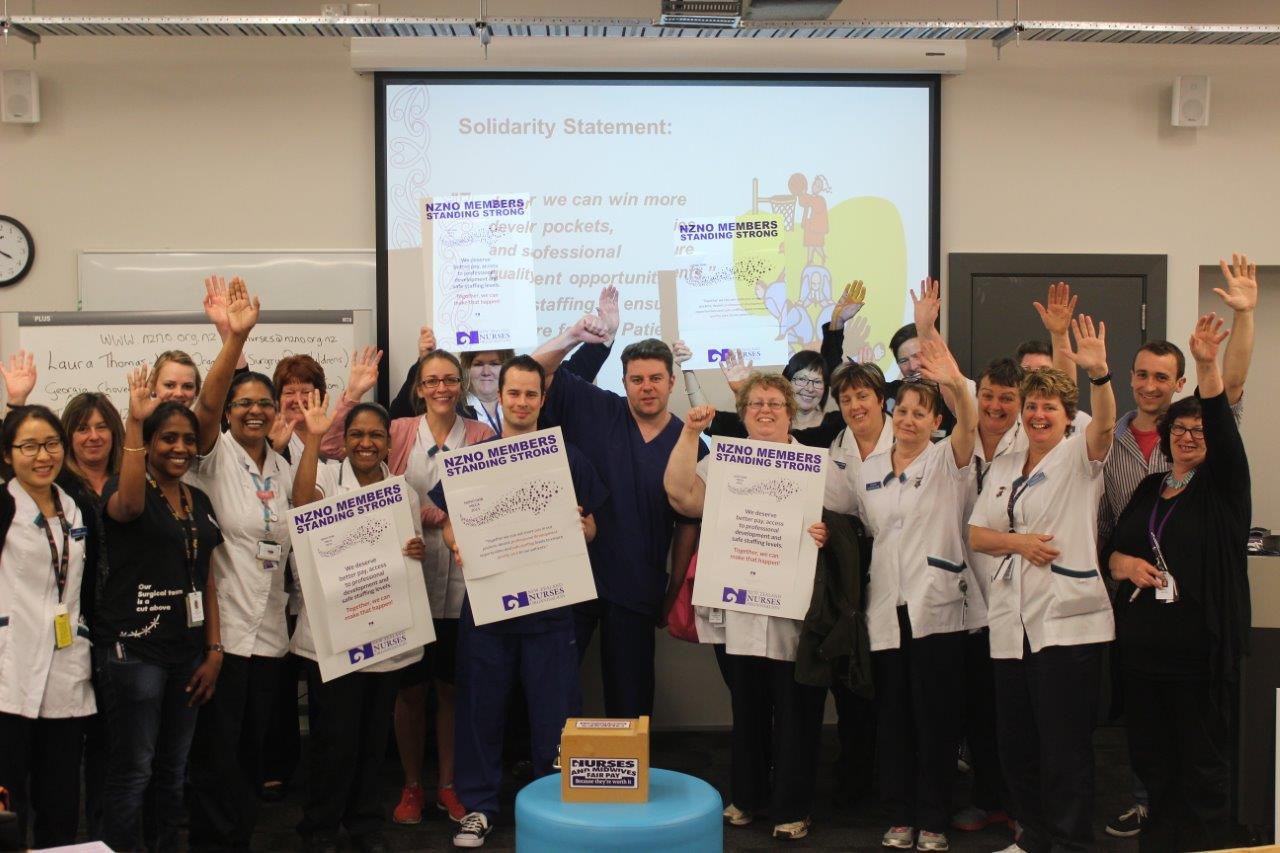
There you can show your support, like the Wellington Hospital members in the photo, for this solidarity statement:

“Together we can win more pay in our pockets, decent professional development opportunities and safe staffing to ensure quality care for our patients”.


2 Comments

Value our elders by valuing us

2014-10-01 Day of the older person FB picToday is International Day of the Older Person; a day to celebrate the achievements and contributions that older people make to our society and tackle the barriers faced by older people.

American politician Hubert H. Humphrey was paraphrasing Ghandi when he said “…the moral test of government is how that government treats those who are in the dawn of life, the children; those who are in the twilight of life, the elderly; those who are in the shadows of life; the sick, the needy and the handicapped.

He’s right. And there’s plenty that NZNO members might want to say about that (check out NZNO’s priorities for health here), but let’s have a look at how we value our older citizens today.

The government approach to care of older people in Aotearoa is ageist. By under-funding this sector, the government is signaling that older people don’t matter. And by extension, neither do the workers who care for them. Staff in residential aged care facilities are some of the lowest paid workers in New Zealand, and successive governments, for over 20 years, have allowed that to continue.

In one of our many submissions to government we put it this way:

The high cost of providing substandard aged care is unsustainable and unjust: public health resources are unaccounted for; where there is a failure of care it is public health which ‘picks up the tag’ for care it has already paid for; services are being contracted out for care of our parents and grandparents with even less protection for their physical and mental wellbeing than for their financial wellbeing; public safety and our professional health workforce are being undermined: and an underclass of undervalued and underpaid workers is being embedded in our workforce while highly educated workers are leaving.”

That’s not valuing our elders or the people who care for them. We are failing to provide sufficient protection for the health, welfare and financial stability of either older people or those who work with them.

So, how do we change things? How can we show older people the respect and dignity they deserve?

Well, one way of doing that would be to value the people who care for them, and there’s a few ways of getting there…

Increase government funding to residential aged care providers; it’s just plain unfair that health care assistants and caregivers who work in aged care facilities get nowhere near as much as their colleagues who work in DHBs. The Government also needs to make sure that funding is passed on to workers, not retained as private sector profits.

A quality, nationwide training and education programme would achieve two things: consistently provided quality care for residents and a career pathway that would attract and retain great staff.

Regulate for safe staffing! Our members want to provide quality care, but at the same time as residents care needs increase, our members face continuous cuts to care hours. How can workers enjoy their work when they are stressed, overworkerd and worried about missing something and making a mistake? There must be enough staff to provide quality care for every resident.

None of this is rocket science, and none of it is news to the sector or the government. All that’s needed now is action! Action to value older New Zealanders and the people who care for them.

Our elders should be valued and celebrated. The workers who are carrying out the responsible and skilled work of caring for our elders should be valued, celebrated, admired and supported for their important work too.


1 Comment

Referrals from ED to primary care

B7_emergencyIn a bid to reduce patient numbers Southern DHB announced this week that it would implement a new system in its Emergency department, where patients not deemed in need of urgent medical attention would be asked to see their GP instead.

Those unable to afford to see their GP would be issued with a voucher. Southern PHO would be the partnering community provider of GP services.

Southern PHO head, Ian Macara wasn’t keen to publicise the vouchers though:

”We don’t want to set up a free service – that all you’ve got to do is trot down to your local ED and get a voucher and away you go.” 

The new Southern DHB system proposes that a triage nurse (if comfortable to do so) would have a conversation with a patient and ‘encourage’ them to see a GP instead. If cost was a barrier a voucher could be issued.

Southern DHB says they are not turning patients away, merely “offering the patient the choice of an alternative treatment provider.”

NZNO was asked our view of the new system. Our answer is – it must comply with Ministry of Health guidelines on the interface with primary care.

Making sure every single New Zealander has access to Emergency Departments is a fundamental part of our public health system.

The decision to treat someone in ED or redirect them is a clinical decision with clinical and professional accountabilities for the health practitioner.  We all know what happens when something goes wrong!

According to the plan, the burden of this work will fall on registered nurses.  Our members were not part of the design of this local system and we fear they may be pressured to reach targets, either of acuity or numbers of patients seen in ED.

Not only that, but the system is counter to the Ministry of Health NZ guidelines on the interface with primary care, which includes the important proviso that ‘encouragement’ to leave ED and make an appointment with a GP instead should not occur at the triage stage of the process. Triage does not accurately determine the appropriateness of a patient’s condition for presentation at either the ED or primary health care.

The Ministry of Health guidelines also state that the NZ public will not be declined care in emergency departments.

If the system does not change at Southern DHB, patients will not receive the assessment/diagnosis that must happen before a decision is made, triage nurses will be at risk and their workload will increase greatly.  This is not good for patient safety.

Nurses should have been part of the planning for this process and now need to have education on the redirection process, including the understanding of professional accountabilities.

NZNO will be working with Southern and other DHBs to ensure patients and staff receive high quality care, where and when they need it. The College of Emergency Nurses NZ -NZNO is drafting a position paper to detail responsibilities. We’ll link to that when it is finalised.

Below are the relevant sections of Ministry of Health’s 2011 guidelines on the Interface with primary health care.

2. Referring patients from ED to primary health care for ongoing care

2.4  The extent of ED care prior to referral to primary health care will vary, but the guiding principles should be that sufficient assessment/care is undertaken so that ED staff are satisfied that the patient is clinically:

  • safe (a need for alternative or more urgent care does not appear to be needed);
  • comfortable (distressing symptoms are addressed); and
  • appropriate (sufficient diagnostic work-up has been done so that there is reasonable certainty that primary health care is best suited to continue the patient’s management).

4. Identifying and referring patients for whom primary health care is better suited to meet their needs

4.4  However, referral to primary health care may occur if further clinical assessment determines that primary health care is better suited to meet the patient’s needs. This clinical assessment must be over and above the usual triage process and should ensure that the criteria in paragraph 2.4 are met. In addition, referral to primary health care in this context must:

  • be facilitatory and not against the patient’s wishes (ED care should not be denied);
  • be based on a high level of comfort from the assessing clinician that referral is best for the patient (the assessing clinician must not feel any institutional pressure to ‘refer’ patients to primary health care and must be protected from any undue risk associated with the referral of patients); and
  • occur in the context of a responsive primary health care service (the patient must be able to be seen in primary health care in an appropriate timeframe for their condition).


9 Comments

Apology needed, stat!

Apology - Street ArtLast week an odd article appeared online and in the Dominion Post praising Hutt Hospital for taking on the lessons of Unilever soap factory.

Along with description of the hospital’s new “nerve centre”, with its centrepiece of four huge screens displaying brightly coloured speedometers, bar graphs and traffic lights, there were some other, more depressing, comments as well.

Hospital manger Peng Voon implied that staff were regularly dishonest; “hiding beds”, lying about the time scheduled to change dressings and saying that a culture change was needed.

While there is no doubt that the new system means things are working more smoothly, it is absolutely no fault of the nursing team that they weren’t previously!

At NZNO we hear about stressed and overworked nurses with not enough resource to consistently provide the quality of care they wish to. At the DHB, overtime has been stopped (unless pre-approved), so nursing staff are absolutely at breaking point.

I have heard that the awful comments made about them have brought some nurses to tears, and others to anger. What a shame that what could have been a positive article for the hospital and staff should have been ruined by the undermining comments of someone who seems to have lost her faith in nursing.

Nurses at Hutt Hospital want an apology and we at NZNO certainly think they deserve one.

Apparently the Chief Operating Officer, Peter Chandler has apologised for the comments on the hospital intranet but that’s not enough. The comments were made publicly, to a readership in the tens, if not hundreds, of thousands – his apology must be made publicly too.

Hutt DHB, your staff deserve an apology, stat!


Photo credit: Phil King via Flickr


3 Comments

Nelson ED nurses get together to create change

successNZNO members at Nelson Hospital have had their voices heard. They have successfully advocated for quality patient care and a safe environment for staff.

ED staff have been concerned for some time that their work is being compromised by a lack of staff, and all the flow on effects of that situation.

Reportable events about staffing levels had been logged but no action taken. NZNO College of Emergency Nurses guidelines for nurse/ patient ratios were not being met and nursing staff were concerned about the potential for breaches of the Health and Disability Commission code of patient rights.

The ED was experiencing an increased number of high acuity patients and Government targets were not being met. Staff vacancies were not being filled in a timely way and staff were worried that more vacancies were coming up. Annual leave requests were being turned down and staff were becoming more and more stressed and fatigued. They were overworked and overwhelmed.

It’s pretty hard on morale if you work in an emergency department and you don’t have the resources to deal with an emergency!

It’s often difficult to see the wood for the trees when you’re feeling like that, so it is a testament to the courage and wisdom of NZNO members that they made a decision to do something about it, and then followed through.

A meeting with the Director of Nursing and Midwifery and the Nelson Associate Director of Nursing was called and members told their stories one by one. It was a powerful and moving meeting. Staff were honest, passionate and resolute that the situation needed to change. That was 2 weeks ago.

Within 2 days the numbers had been crunched and ED staff were notified that an extra 2.14FTE had been approved and were being advertised. In the interim, casual staff are being used to ease the workload.

It’s a great outcome, and one that only happened because NZNO members worked collectively to address their concerns. When we stand together we are heard.

Ehara taku toa i te toa takitahi. Engari, he toa takitini.

Success is not the work of one, but the work of many.


5 Comments

Growing our advocacy out of the ward

advocacyGuest blogger Erin Kennedy is a senior CCDHB delegate. She has a long history as a union advocate and is passionate about empowering members to work together towards a better working life.

Last week, Radio New Zealand asked to speak to a nurse about what it’s really like working at Auckland DHB in an environment that is understaffed, under resourced and, at times, unsafe.

Not surprisingly, there were no volunteers from Auckland’s current staff.  Most nurses are swift to advocate for patients on immediate clinical matters, but not so forward in publicly speaking out for patients and the health system, fearful that they risk their jobs if they do so.

This is a real worry.  How often have you shuddered at a horror story told in the tearoom, or heard a colleague declare that “I wouldn’t let anyone from my family stay on that ward…it’s just not safe”.  Surely the public has a right to know what is happening in our hospitals.

Dunedin nurses acted together this month to speak out about safety issues in the south. Sadly, nurses all over the country face the same problems – unsafe staffing levels, difficulty taking minimum breaks, problems getting study leave to maintain their PDRP and rosters which do not meet the MECA.  No wonder they feel burnt out and unsupported.

There are many ways nurses can make their voices heard. Speak to your local MP – most are readily contactable, particularly in an election year. Explain to relatives why bells cannot always be answered promptly, or why there is nobody to watch their demented relative and keep them safe. Take five minutes to fill out a reportable event documenting problems. Yes, reportable event forms disappear into a black hole at most hospitals but they still provide essential data when safe staffing and other issues are under the spotlight.

But the most effective voice nurses have is through NZNO – go to meetings, have a voice and keep your delegates and organisers informed about what is happening in your area.