NZNO's Blog


3 Comments

The underfunding of DHBs

Bill Rosenberg is the Policy Director/Economist at the New Zealand Council of Trade Unions Te Kauae Kaimahi. He is widely published on globalisation, trade and e-learning. You can read Bill’s monthly economic bulletins here

For the past five years, the Council of Trade Unions has analysed how much was approved for Health spending in each year’s Budget. The theme is “Has Health been given enough to stand still?” We look at the costs, the population pressures including the ageing of the population, and the promises for new services, and compare them to what is actually provided. You can see the reports which give details and show the assumptions we used here.

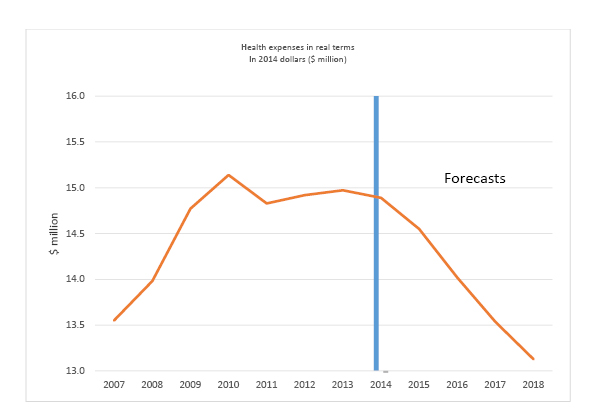
Treasury estimates of real changes in health spending after costs and population growth.health expenses
In the 2014 Budget we estimated that the Health Vote was $232 million behind what is needed to cover announced new services, increasing costs, population growth and the effects of an ageing population.

The Health Vote increased by $307.9 million in operational funding overall between Budget 2013 and Budget 2014 (from $14,134.6 million to $14,442.5 million). This is $185.6 million short of the $493.5 million we estimated was required just to keep up with costs without providing for new and improved health services. However the Budget in addition introduced “new policy initiatives” costing $120.1 million in 2014/15 (putting aside the bulk of the “initiatives” which were actually funding towards increasing costs and population pressures), bringing the total needed to $613.5 million. This was offset by “savings” totalling $73.6 million including $56.7 million that are not explained, plus a reduction in the provision for risks such as epidemics or natural disasters of $17.0 million. If we take the savings at face value, the total shortfall is therefore $232.0 million.

District Health Boards (DHBs) were underfunded by an estimated $94 million just to cover increased costs and demographic changes. When the costs of new services which the DHBs are expected to provide are taken into account, the shortfall is likely to be well over $100 million.

Centrally managed national services such as National Disability Support Services, National Elective Services, National Emergency Services, National Mental Health Services, Primary Health Care and Public Health services received $134 million below needs.

We don’t look at capital funding in any detail, but it rose sharply: from $520 million in Budget 2013 to $1,114 million in Budget 2014. This follows a significant increase in capital expenditure last year. In the 2012 Budget, $289 million was budgeted for capital. The Ministry of Health had observed in its Four Year Plan that “Capital investment is needed nationally because a significant proportion of hospital buildings are in poor condition[1]. While the increase in capital funding is much needed, increased capital assets create additional costs for DHBs because they have to pay the government capital charges and must provide for depreciation. As Treasury noted in 2013 Budget papers, “new capital builds are more likely to result in large deficits for DHBs”[2].

We also had a look at the cost of the welcome policy initiative to enable children under 13 to have free access to GPs and free prescriptions from 1 July 2015. Our estimate was that it could cost closer to $40 million per year rather than the $30 million in the Budget estimates.

How good are our estimates, and what about the forecast funding for the four years to June 2018 which are part of the Budget? In past years, Ministry of Health estimates of the funding shortfall were released, but they were largely redacted from documents released following the 2013 Budget.

However, for the year to June 2015 (financial year 2014/15) Treasury is forecasting health to have a real growth of negative 2.3 percent according to its spreadsheet issued with the Budget. On their figures we calculate that represents a shortfall of $360 million. So our estimate is conservative.

Greater cuts are forecast for the following three years. In the event, Health could get some more from the ‘operating allowance’ for new spending in those years but not enough is being allocated for this to cover the shortfalls in all the areas of the forecast Budgets, most of which will be in a similar position to health. (See the May CTU Economic Bulletin for more detail.)

Treasury estimates of real falls in Health funding after costs and population growth(Fiscal Strategy Model, 2014 Budget)
Year to June 2014 2015 2016 2017 2018
Percent -0.6% -2.3% -3.7% -3.6% -3.1%
$million -$82m -$360m -$587m -$559m -$488m

Treasury warned in the preparation of the 2013 Budget that such cuts would require major changes to our health services. This could include “more targeted services and funding” which implies dropping services, making some available only to certain groups, or introducing user charges[3].


[1] Vote Health 4 Year Plan for 2013/14 to 2016/17, December 2012, p.14, available at http://www.treasury.govt.nz/downloads/pdfs/b13-info/b13-2659847.pdf.

[2] Treasury Aide Memoire to Ministers of Finance and State Services, 6 December 2012, p. 6, available at http://www.treasury.govt.nz/downloads/pdfs/b13-info/b13-2505130.pdf.

[3] “Four Year Plan – Assessment and recommendation on final four-year plans submitted by Ministers to MoF and MoSS”, p.4-5, available at http://www.treasury.govt.nz/downloads/pdfs/b13-info/b13-2564298.pdf.

2 Comments

Sometimes it’s the little things that matter

dinoScrubsWe all know there is cost cutting going on everywhere in the health system at the moment. DHBs are being forced to cuts tens of millions of dollars from their budgets and cost cutting measures (called “savings”) are being implemented in every ward and unit.

We hear every week about community health initiatives whose contracts with the DHB have been slashed. Clinics for refugee and migrant and other high needs populations are disappearing, aged care contracts are being squeezed and every hospital in the country is facing cut after cut after cut.

We know how stretched the nursing team is. Not being able to take annual leave, being called back from annual due to short staffing, vacancies not being filled, care being rationed – we hear sad stories every day.

I think it’s hard for people to get their heads around what’s actually happening in our health system. It’s hard to believe because when they or a loved one are in hospital the care they receive from the nursing team is so professional and they feel well cared for.

Today I heard that one hospital is stopping paediatric nurses from wearing bright, cartoon character scrubs. It’s a cost cutting measure. From now on all staff will wear the same plain blue scrubs.

That might not seem like a big deal; might seem sensible, even. But it’s not. It’s the little things that matter.

Being in hospital is one of the scariest things a sick child can face, and it must be pretty traumatic for family and whānau as well. Part of good nursing practice is to make the experience as comfortable as possible under the circumstances, and wearing bright, cartoon character scrubs is one way a nurse can help an ill child feel safe.

Putting paediatric nurses into plain scrubs might save the DHB a few dollars but the affect it will have on patients and families is more important than saving a few pennies. The philosophy of patient-centred care that turned paediatric wards into bright, sunny and interesting places with brightly dressed nursing staff, designed to put children and families at ease, is being turned on its head. It won’t be long now till children’s wards will be back like they were in the bad old days – dismal institutionalised places, not kid friendly at all.

That’s not what I want for our health system.


The image is from http://www.mightynurse.com/the-5-ws-of-pediatric-nursing/


3 Comments

The long road to justice at Capital and Coast DHB

leave entitlementCapital and Coast DHB (CCDHB) delegate Erin Kennedy talks about a workplace situation where holding the DHB to account has taken years. The hard work and perseverance of delegates and organisers has finally paid off.

After several years of work by NZNO organisers and delegates at CCDHB, members whose shift leave was not calculated correctly look set to finally get the leave they are due. Staff affected worked alternative rosters (10 and 12 hour shifts). CCDHB has reviewed records of affected staff from 1 January 2007 to 1 January 2013 to determine which staff are owed leave, with ICU used as a pilot group.

Previously, all shift leave was credited based on shift count under clause 13.2 of the MECA. However, clause 6.19 of the MECA, which covers alternative rosters, states that on completion of one year on alternative rosters, employees should receive one week of shift leave in place of the provisions set out in clause 13.2.

While delegates and organisers are pleased that, at least in one directorate, the end is in sight for this project, we still have some concerns. The first is that a number of staff who have left CCDHB have not been able to be contacted.

If you worked alternative shifts at CCDHB during the time covered, please contact CCDHB to ensure you receive any leave due (gary.waghorn@ccdhb.org.nz). If you know someone who has left CCDHB and who may be covered, send this on to them. Although NZNO does not normally support cashing in of leave, on this occasion the cashing in of leave is supported, as staffing in some areas prevents any extra leave being taken.

Our second concern relates to members who may have had leave over-calculated.  Letters set to go out from the DHB ask those staff to sign a form agreeing to pay back any overpayment, either in a lump sum or as salary deductions.  Our view is that the Wages Protection Act kicks in here, and our advice to those staff is not to agree to any repayments without union advice. That advice regarding alleged overpayments also applies to other staff who have recently been asked to repay money which CCDHB claims to have overpaid, including senior nurses on the PDRP. If this applies to you, contact a delegate immediately.

NB: The ICU project which involves correcting miscalculated “adjust to normal” pays is a separate one, which will hopefully soon be concluded and staff paid out.  Again, if you worked at Wellington Hospital’s ICU and think you may have been affected by this, please contact CCDHB.

You can read the multi-employer collective agreement that covers NZNO members and DHBs here (it’s a pdf).


Leave a comment

Midwives: changing the world one family at a time

Midwives day 2014On International day of the Midwife, a midwife and NZNO member talks about her profession.

Last Friday, while traversing the corridors of the tertiary hospital where I work, I met a fellow midwife whom I’ve known for more than 20 years, though our paths seldom cross these days.

While she’s been self-employed for decades, providing care for women whose pregnancies are, for the most part, categorised as “low-risk”, I am a DHB employee, working with women whose experience of pregnancy and birth is radically affected by medical complications.

The rhythms of our day-to-day practice differ markedly, but at the heart of both is a commitment to offering skilled support to women through one of the most profound experiences of their lives. We each acknowledge the vital part the other plays, two among a variety of roles, all of equal value, which constitute midwifery as a whole.

Our meeting reminded me of how much this solidarity of purpose means to me; it is a saving grace when the pressures of working within the increasingly stressed and under-resourced public health system feel overwhelming and unsustainable.

My friend and I made the most of the opportunity to “vent” about how governments, hospital administrations and statutory bodies often make our work harder through ill-conceived laws, policies and regulations.  When we parted company I felt fortified, and I hope that she did too.  I consoled myself with the thought that while governments and their institutions come and go, the things that really matter survive and flourish in spite of them.

On International Midwives’ Day what’s on my mind is that women need midwives, and midwives need each other – that does not change. Let’s look after each other.