NZNO's Blog


Leave a comment

A year of chaos

Kerri Nuku, Kaiwhakahaere
NZNO Tōpūtanga Tapuhi Kaitiaki o Aotearoa

As another year draws to a close I am reminded of the whakatauaki, Ka mua,ka muri – walking backwards into the future. It suggests that time is a continuum, with the past present and the future connected and where learning from the past can help inform future actions.

Having just completed the national Te Whatu Ora strike for safe staffing and fair pay, further questions being raised in the media about the health budget, I wonder what learnings we can take from 2024.

The year has been fraught with (among other issues) conflicting messages, their lack of proper communication and consultation and a legacy of destruction.

At the start of the year there was a general acceptance among nurses and Te Whatu Ora that there were approximately 4000 nurse vacancies across the sector – a fact acknowledged in the build up to the 2023 elections. By March the cracks began to surface with Budget issues announced blaming over recruitment of personnel, especially nurses as the significant contributor to budget blow out. Te Whatu Ora were instructed to collectively save $105 million by July using ‘cost containment’ methods including banning double shifts, pressure to take leave, non-replacement of sick staff and wiping unfilled roles.

All the while offering reassurance to the public that none of the cost saving methods will impact the level of care patients receive. Despite reassuring messages patients were impacted and the health professional alike all expressed serious concerns about burn out, fatigue and staffing pressures.

Then the announcement of a recruitment freeze for non-patient-facing hospital roles followed together with the hiring limited places available for the mid-year intake of new graduate nurses. We were told in the nine months from June 2023 to March 2024, 2886 nurses were recruited. There was no mention of retirements in an aging workforce, resignations and nurses migrating overseas, especially to Australia.

In June NZNO released accessed information under the Official Information Act (OIA), Te Whatu Ora data showed more than a quarter of nursing shifts were below target staffing numbers, and some wards operated below safe staffing levels nearly all of the time. NZNO did not receive responses from Te Whatu Ora, something wasn’t adding up ,how can we reassure the public of quality health care when Te Whatu Ora data identified nursing shifts were understaffed.

Then it seemed to make alittle more sense , the Commissioner is reported as saying “there are too many nurses for the budget ’’while the CEO of Te Whatu Ora acknowledges the new 3000 nurses are needed for patient safety. So what and who sets the budget -are we working for determining what quality of care looks like to meet the needs of the community and staff accordingly or are be setting a budget based on funding cuts and recruiting the nurses to fit the budget.

The burning platform is what about the other parts of the sector , the impact on rural communities where staffing and funding is impacting of the quality and accessibility of services to these communities, or how about nurses in Primary care and community how well are they supported to cope.

As we walk into 2025, I can only encourage the Minister to stop talking to the sector and talk to the nurses, health care workers and tauira we are all in healthcare to make a difference that I am sure of.

We can’t continue to walk confidently into the future without a comprehensive long term workforce plan designed by those with real knowledge of the issues.


Leave a comment

Health Justice – The mana of our mokopuna

Kerri Nuku, Kaiwhakahaere
NZNO Tōpūtanga Tapuhi Kaitiaki o Aotearoa

This week, reports came out of tamariki in Ōpōtiki left alone after armed police raided their homes and arrested their parents. A kuia and her daughter-in-law strip searched for no clear reason. Other tamariki were left at school with nobody to collect them.

The police minister vehemently denies it, but Māori parents know all too well that these stories aren’t made up. Too many of us have too many similar stories to believe otherwise.

No mokopuna should ever have to go through the trauma of seeing their parents arrested to then be left to suffer alone. 

This Government’s ‘tough on crime’ approach is not only ineffective but is also producing a new generation of traumatised tamariki and rangatahi. 

Dame Whina Cooper said, “Take care of our children. Take care of what they hear. Take care of what they see. For how the children grow, so will the shape of Aotearoa.” 

That couldn’t be more relevant than now. 

How we treat tamariki and rangatahi, and especially how we treat the mokopuna of those we believe to have done social harm, is one of the most significant reflections of the moral sensibility of a society. 

And how do we see Māori, African American, Palestinian, Aboriginal and First Nations tamariki and rangatahi being treated? They are criminalised, put into abusive state care, and traumatised through over-policing and an injustice system. 

This all reflects pure dehumanisation. It shows a racist ruling class that believes that it is ok to trample on the mana of mokopuna. More than that, it shows a government whose definition of justice causes further intergenerational trauma through force and fear.

It is a dark week, where the Treaty Principles Bill has been introduced early in a cowardly attempt to avoid the mass hīkoi happening down the motu. 

In this darkness, there are so many lies spread about who should make decisions and what equality means. After all, the Treaty Principles Bill says, in essence, that the colonial government can do what it likes irrespective of what actually works for tangata whenua – like boot camps or Oranga Tamaraiki. 

That’s why it’s important to remember that contrary to whatever the Government will try to have you believe, Te Tiriti o Waitangi is all about justice. It’s about hapū and iwi doing what they know best to make the world safe and prosperous for their whānau and mokopuna. Part of that is dealing with social harm through our own tikanga.

As health workers we must think more broadly about health justice broadly, we see the physical, emotional, and mental toll of racism, colonialism and dispossession first hand. 

So, to re-focus us we need to return again to the words of Whina Cooper.

“Take care of our children… For how the children grow, so will the shape of Aotearoa.” 

What shape do we wish to see? Can’t we see that how we care for our children is how we care for our future? Don’t we wish for justness that upholds the mana of our mokopuna? 

I know what kind of Aotearoa I believe in. It is own time to be courageous and shape Aotearoa.


Leave a comment

Our voices must be heard

Kerri Nuku, Kaiwhakahaere
Tōpūtanga Tapuhi Kaitiaki o Aotearoa NZNO

These are interesting times we live in. At a recent convention I attended I was asked a very interesting question about the power of a voice on global health. My response was a simple but one that rings true through the mists of time. “Throughout history the power of the voice can inspire people and make them brave, or it can diminish people by the language and the tone of voice.”

The voices of many historical figures – both good and bad – have left indelible marks on humanity and its impact on nurses has been no different! Over our history, we’ve largely been silenced by the dominant forces within the system.

So, the big question is how do nurses get that voice we long for in order to tell our story when that the voice has been stripped away from us through legislation, through policies and practice in many situations? Now more than ever it’s important that our stories be heard. One such example is the OIA NZNO obtained from Te Whatu Ora. This provides a platform for us to inform the data when it comes to getting the truth out there. This can be done by our union lending support to our nurses by giving them the courage to regain that confidence and strength. We need to protect them in a quite hostile environment where it’s not okay for nurses to speak out.

Many of our legislative decision-makers only put forward only a medical view.  Pae Ora for example looks at having doctors as part of those decision-making groups. Nurses are excluded. It raises the question again about why the voices of nurses are silenced. Is it because of the more historically subservient role that nurses play? It’s the stereotypical approach and still a hangover from the old ways! It used to be that women should be seen and heard, in many ways that archaic attitude still exists. This marginalisation is only worse if you’re Māori or another minority group.

It’s taken a few brave women to really challenge the status quo and we need to support them. The way forward is to look at what leadership looks like within nursing. And those nurses that are speaking out have got to see that there’s a group of people around them, and not just a few individuals popping up. It is the responsibility of the union to support and promote the freedom of a voice, and to protect the interests of nurses that speak out.

Through our struggles we’ve always got to be optimistic for change because our purpose in life right is to make it easy for the people coming behind us. It does take some solid action and solidarity and that’s why our Ratio Justice bus tour requires more than just a few people to turn up, but we need crowds present who need to make their voices heard loudly and clearly.


Leave a comment

IQNs not the long-term solution

Kerri Nuku, Kaiwhakahaere
Tōpūtanga Tapuhi Kaitiaki o Aotearoa NZNO

There has been some media focus recently on Internationally Qualified Nurses (IQNs) being exploited by recruitment agencies taking advantage of monetary incentives offered by the Government.

These agencies are bringing IQNs into the country without first securing them employment  which leads me to reiterate what I’ve been saying in the media. We uphold the importance of ethical recruitment. We have serious concerns about the recruitment agencies that are incentivised to flood Aotearoa with nurses, particularly from India. These nurses are often unable to be employed despite completing New Zealand’s competency assessment programme and holding NZ practising certificates (APCs).

That many recent IQNs are not being employed is through no fault of their own. IQNs are not always professionally or culturally suitable for employment in positions where local experience is required. It puts a strain on the system with training, culturalisation and finding effective support for them once they’re in jobs. The levels of support required to upskill them costs too much, so often they’re left to drown in the deep end.

It has been revealed to me recently that these agencies are also exploiting loopholes in the system to bring nurses into Aotearoa via the UK’s National Health Service. If not already illegal this kind of activity should surely be shut off as it is in my opinion tantamount to fraud.

This cannot continue and Te Whatu Ora has recently assured us that the $10,000 incentive to agencies has been closed But will the funding now be diverted to growing our own workforce where it should have been in the first place?

It’s time we realised IQNs are not the solution to the nursing shortage in Aotearoa even in the short term. Our focus should be on strategies to attract New Zealanders rather than IQNs to take up nursing study with the aim of building a strong workforce that is culturally competent and responsive.

We are aware of the harmful effects of international nurse recruitment which according to the International Council of Nurses some associations in poorer and developing countries equated with a form of neo-colonialism. IQNs are needed in their home countries as much as they are here, and this is another reason why more effort and resources need to be put into growing our own workforce.

The Government now needs to consolidate the situation with the existing number of IQNs in the country to ensure they get jobs along with appropriate training and support and this means we need to freeze the recruitment of IQNs and discourage recruitment agencies from bringing them out.
It needs to divert any possible funding into broadening the number of nursing students and then training them, keeping them, and giving them good jobs afterwards. That would be the long-term solution to this nursing crisis.


Leave a comment

Get up, stand up. Don’t give up the fight!

Anne Daniels, President
NZNO Tōpūtanga Tapuhi Kaitiaki o Aotearoa

Late in 2023 NZNO CE Paul Goulter outlined NZNO’s priorities for 2024. First and foremost is achieving Pay Parity for nurses working outside of Te Whatu Ora. Consequently, on 8 December NZNO raised a Pay Equity claim for Primary Health Care members involving more than 500 employers. We are standing up and fighting the roadblocks in our way.

Heading into 2024, the NZNO Board has prioritised member health and safety. Paul Goulter recently said, “We need to ensure that nurses and health care workers work in safe workplaces and that they are unafraid to press for their rights.” Specifically, we will be standing up and fighting for our right to safe staffing through legislated nurse-to-patient ratios underpinned by CCDM.

Health and safety is everyone’s business, including Government, employer and employee. The Government’s job is to provide legislation and policy. A guiding principle of the Health and Safety at Work Act 2015 is that workers and others need to be given the highest level of protection possible from workplace risks.

Employers and employees need to uphold legislation and standards in practice. The employer must engage with the workers and enable them to identify and manage risks (physical or mental) in the workplace. Employers must “ensure there are sufficient health care and support workers on duty at all times to provide culturally and clinically safe services” (Health and Disability services (safety) standard 2.3.1). But we all know that is not happening.

Research tells us that appropriate levels of nurse staffing is critical to patient safety. The CCDM system matches staff resources to patient care need supporting a better working environment but is yet to be fully funded or implemented after 20 years of asking.

The lack of Government or employer commitment is telling – every time a nurse writes an unsafe staffing incident report. My request to Te Whatu Ora and the Ministry of Health to provide numbers around reports of unsafe staffing over the last five years was declined because “it would take too long and too much resource” to provide me with an answer.

Te Whatu Ora is required to “follow the National Adverse Event Reporting Policy for internal and external reporting… to reduce preventable harm (HDSS 2.2.4). Therefore, Te Whatu Ora and the government are legally required to resource data collection and reporting. We will not let this go.

Health and safety representatives (HSRs) around the country have consistently reported unsafe staffing, met with managers and escalated their concerns. HSRs have submitted increasing numbers of Provisional Notices of Improvement to WorkSafe over the last three years but an external review found there are “some instances of known harm where WorkSafe appears to be taking little or no intervention” (Pennington, 2023). This is why we need nurse patient ratio legislation to fund and implement safe staffing (and CCDM) across the whole health sector.

Meanwhile HSRs are making a difference. In December 2023 alone, the Waikato District Nursing Service used health and safety process to gain an increase of eight RN FTE. The HSR said that after asking for years “the Executive now knows we mean business”.

Wellington ED HSRs working with the CCDM facilitator, identified a gap of 67 FTE through Trendcare data. Health and safety caught the attention of media repeatedly through actions taken by member HSRs, e.g. Auckland (Nico Woodward), Gisborne (Christine Warrender), Waikato (Janferie Dewar) where there are chronic failures to safely staff workplaces.

2024 will see us all “Get up, stand up. Stand up for our rights!” (Bob Marley and the Wailers).


1 Comment

NZNO celebrates World Smokefree Day by lodging our smokefree services petition

DSC_0176

Today, the 31st of May is World Smokefree Day. Every year the Health Promotion Agency puts out great resources for people want to quit smoking and stay off tobacco for good. They have infographics to download and motivational facts like the one below. Not many people know that smoking makes you deaf!

Hearing-loss_GIF

Researchers have identified though that without further big changes, New Zealand will not reach our smokefree 2025 goal, particularly for Māori and Pacific communities. That’s why NZNO was distressed when we heard last year that funding for some iwi and community smoking cessation providers was being cut, as well as for advocacy services like the Smokefree Coalition. NZNO Kaiwhakahaere Kerri Nuku said ““It doesn’t make any sense that on the one hand the Government supports the goal of Smokefree Aotearoa 2025, but on the other is pulling funding out of Smokefree advocacy services including the Smokefree Coalition, ASH and Smokefree Nurses. Every day we see the effects of smoking on our patients’ physical and mental health, and the social, economic and cultural wellbeing of their whanau. It’s heartbreaking.”

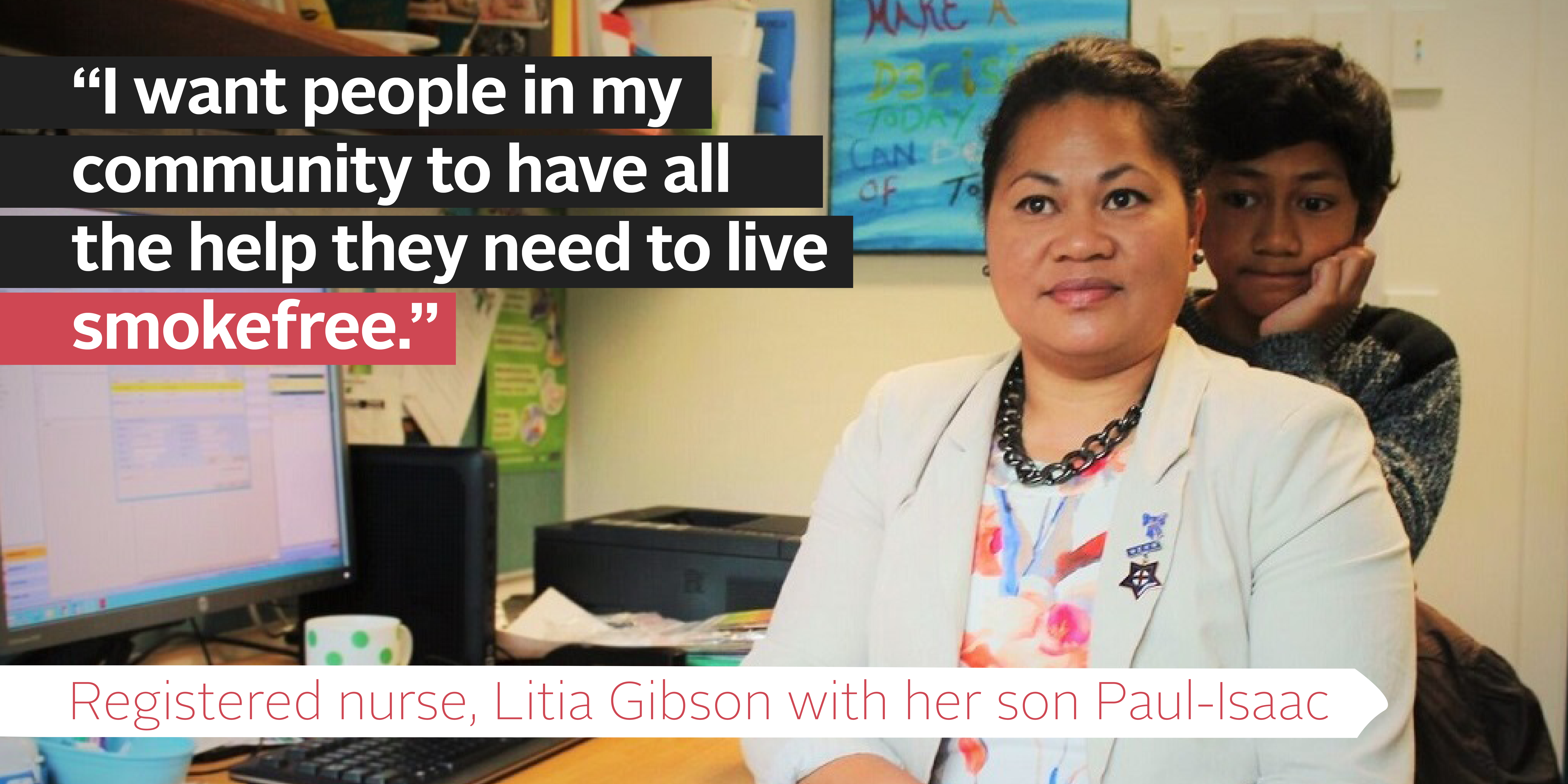
Nurses working to stop smoking in the community say they need advocacy and specialist services to refer patients to and reinforce their stop smoking message. Porirua Community Union’s Litia Gibson talked about the need for these services to NZNO last year in this video. “Any cut will affect all our services. Because it’s not just the services we provide, it’s the patients and the populations that we are caring for who are already in vulnerable positions.”

Social share3.3.jpg

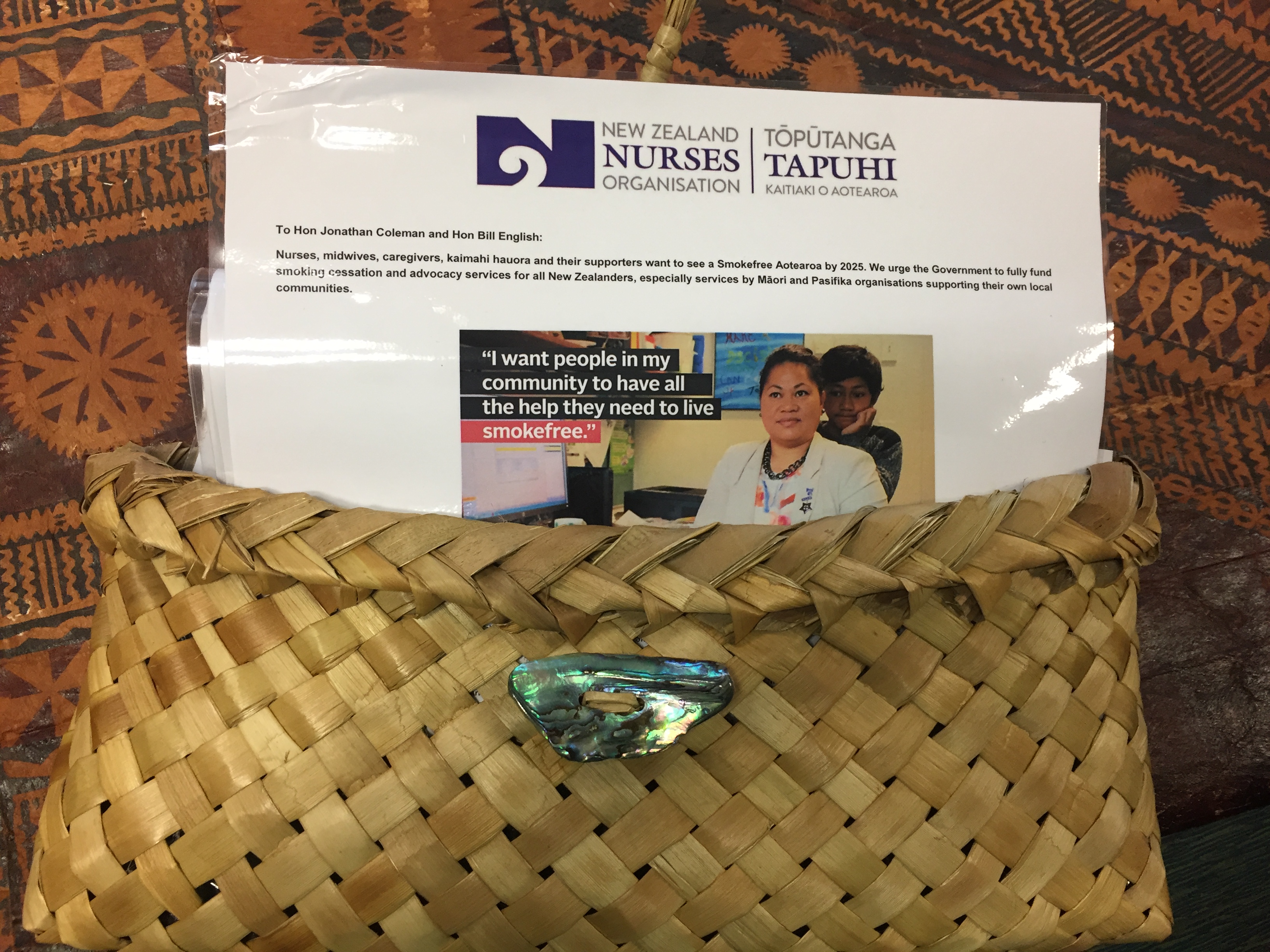
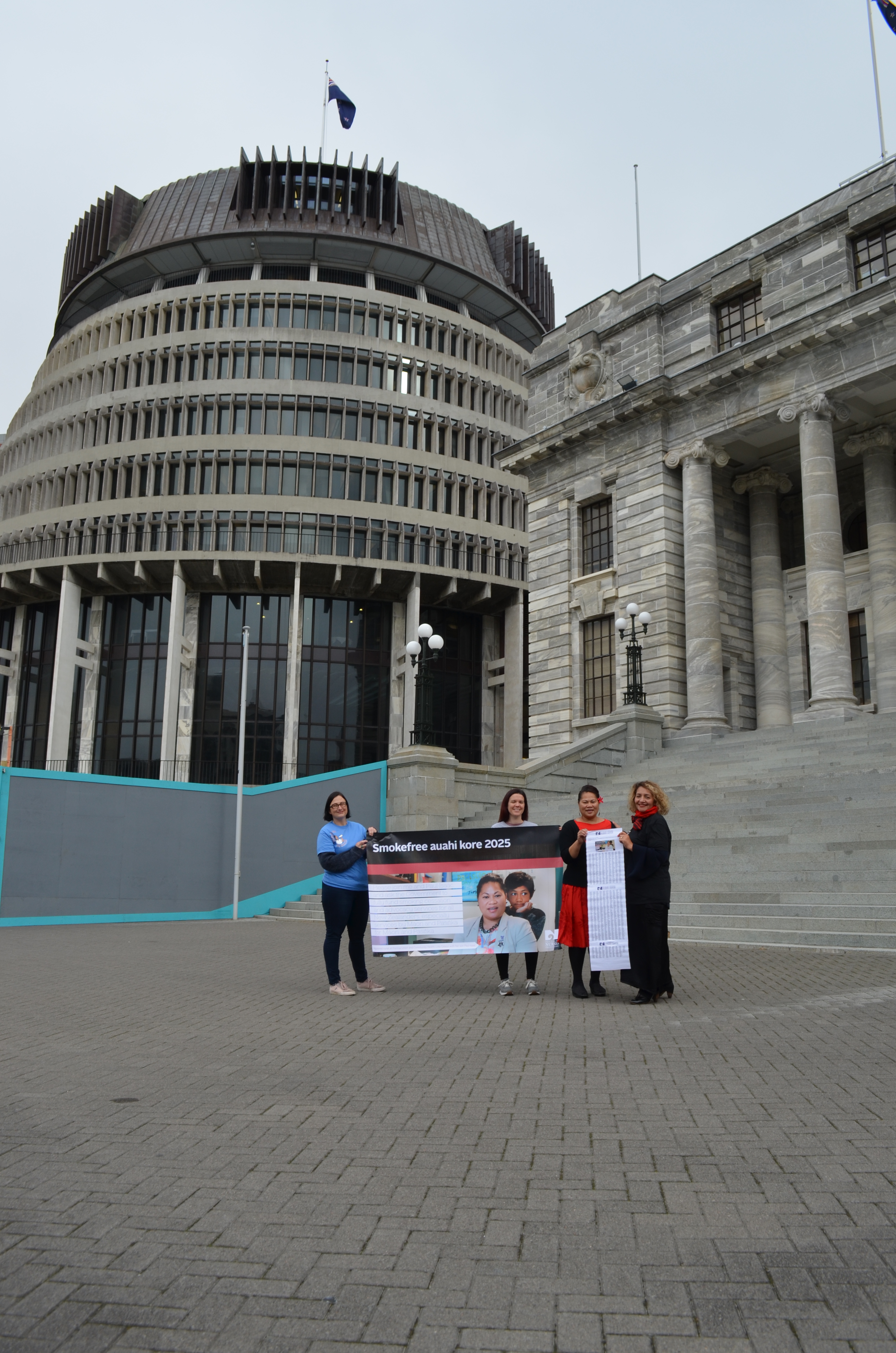
NZNO decided to run a petition with Together, the digital campaigning arm of the Council of Trade Unions, to ask for more funding for these services. Today, we delivered 1823 signed names of nurses, caregivers, midwives, kaimahi hauora and their supporters to Marama Fox MP, in recognition of the longstanding work that she and her predecessors in parliament have done on ending smoking in New Zealand.

Litia and Marama had a little chat afterwards where Litia broke down the issues around referral services and increasing workload for nurses. “Without specialist services, we don’t have the time. You need to pack so much into an appointment, because with health funding where it is, community need is so great.”

Marama agreed on the need appropriate smokefree services and the future benefit this can bring to our country. “Being smokefree puts real money back in the hands of whānau. It protects our future generations, and ensures they don’t have to make the same decision to quit because they never start. It’s all about whānau.”

Marama had brought along a beautiful kete to put our petition in and present it to parliament. Litia in return swapped her red flower to put in the MP’s hair for the afternoon- ‘There, now your outfit is complete!’


We are proud that a little bit of NZNO is being delivered to parliament on World Smokefree day to support our Smokefree 2025 goal. Kia kaha koutou, thank you for supporting this mahi. Your names are now part of history.

IMG_1330


Leave a comment

Nurses go to Fiji

When Cyclone Winston hit Fiji earlier this year, emergency services were on high alert all across the pacific. Those services included a number of NZNO nurses who also volunteered for the New Zealand Medical Assistance Team (NZMAT). Emma Brooks who normally works at the Kenepuru Operating Theatre and Megann Deveraux from the Wellington Regional Hospital Operating Theatre both deployed to Suva with the NZMAT on 1 March. We had a chat to Emma about what happened on the deployment and what it means to be part of NZMAT.

What is NZMAT and who is involved with it?

It’s basically a team of medical professionals that are trained to deploy to disaster areas to support the local health service. There are doctors, nurses, paramedics, allied health staff and even some non-medical members that work in areas like logistics. We all go through training to be able to be deployed. It’s a civilian based group so we aren’t part of the defence forces in any way but we do help with their disaster relief efforts.

What happened while you were deployed?

We left New Zealand on 1 March and flew directly into Suva with the help of the NZ Air force. We were a part of four teams, two of which were surgical, one general, and one orthopaedic and two were primary health. Because I’m a theatre nurse, I was in one of the surgical teams which was based at the Colonial War Memorial Hospital. We were there as support. We had to be flexible in what we did and had to take on the extra work that had been created due to the Cyclone. Our arrival was almost perfect timing as one of the Fijian Orthopaedic surgeons ended up in ICU the day before we arrived.

Over the two weeks we were there, we did 102 surgical cases over 12 days of surgery. These were cyclone and non-cyclone trauma cases and elective surgeries. The othropaedic team even did an emergency inter-island trip to Labasa Hospital on the northern island of Fiji. We were flown there by the French Airforce, however, they didn’t serve croissants or coffee on the flight.

What was most memorable about the deployment?

Working on the victims was by far the hardest thing we did. We did lose a couple people due to the trauma they had endured.  Because of the cyclone, the Fijian health services were stretched, any countries would be, and we tried our best to help where we could. The cyclone had caused such destruction, we had to work with very limited supplies. Having said that, it was a privilege to be there. The people we helped, they all were all incredible

There are various requirements to be able to join NZMAT. Go to the Ministry of Health website to find more information.


1 Comment

Working in partnership for health

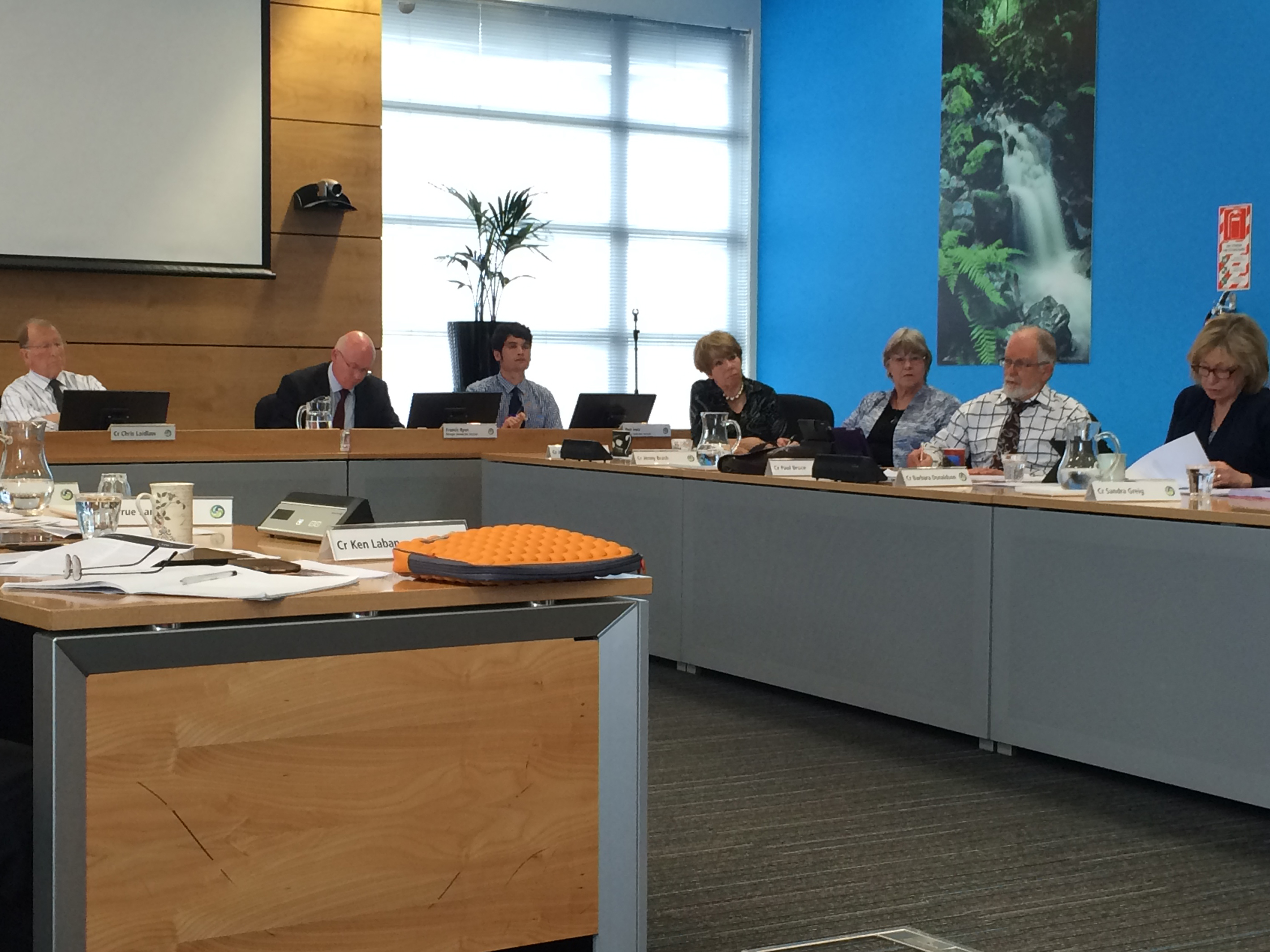
IMG_0103Yesterday NZNO president Grant Brookes, CTU economist Bill Rosenberg and others made submissions to the Greater Wellington Regional Council on a motion brought by Cr Paul Bruce.

Cr Bruce realised that, if ratified, the Trans Pacific Partnership Agreement (TPPA) would constrain the Council from reaching its goals, in many ways. The Council has recorded its opposition to the TPPA.

Grant made the links between people and health, and the environments they live in. Achieving health requires wrap-around thinking and intersecting actions. We all need to be on the same page if we are to realise a healthy Aotearoa New Zealand.

Here’s Grant’s submission:

Kia ora koutou. Good morning. My name is Grant Brookes. I am a registered nurse, and the president of the New Zealand Nurses Organisation.

NZNO is the leading professional association and union for nurses in Aotearoa New Zealand, representing 46,000 nurses, midwives, students, kaimahi hauora and health workers – including four and a half thousand in the Greater Wellington Region.

NZNO embraces Te Tiriti o Waitangi and works to improve the health status of all peoples of Aotearoa New Zealand through participation in health and social policy development.

At present, a major policy focus for the sector is the update of the New Zealand Health Strategy, being led by the Ministry of Health. The relevance of this to Councillor Paul Bruce’s motion will soon become clear.

The previous New Zealand Health Strategy, introduced in 2000, has occasionally been referenced in this Council’s planning.

The updated Strategy, which proposes a clear view of the future for the health system over the next 10 years, is likely to have greater bearing on your decision-making.

This is because an eighth guiding principle for the health system has been added to the existing seven, in recognition of the way the wider environment contributes to people’s health. It is: Thinking beyond narrow definitions of health and collaborating with others to achieve wellbeing.

Particular examples of collaboration between health services and other agencies are mentioned in the Strategy. They include Healthy Auckland Together and Healthy Christchurch.

Healthy Auckland Together revolves around a Regional Action Plan, developed by 21 organisations, including District Health Boards, Primary Health Organisations and the Auckland Council. It views local government domains like transport and regional parks (and indeed local government employment conditions) as part of the health infrastructure.

Healthy Christchurch is a similar, DHB-led collaboration involving local government, based on the World Health Organisation’s Healthy Cities model.

Meanwhile, World Health Organisation Director-General Dr Margaret Chan has spoken of the TPPA as part of a “particularly disturbing trend [involving]… the use of foreign investment agreements to handcuff governments and restrict their policy space.”

And as we’ve just heard from New Zealand Council of Trade Unions economist Bill Rosenberg, the TPPA’s restrictions apply to local government as well – even as your role in creating healthy environments is receiving greater recognition.

As a nurse, I am very concerned that the TPPA will restrict your ability to fully contribute under the updated New Zealand Health Strategy.

So I applaud you for being one of the councils, covering 60 percent of New Zealanders, who have previously voted to express opposition to the TPPA, as it stood.

I now ask you to support the recommendations in Cr Paul Bruce’s notice of motion, especially these parts:

“That the Chief Executive… deliver a report… on the impact that the TPP will have on Greater Wellington Regional Council’s ability to make decisions in the interests of our region, the people and their environment”, and

“That the Council asks that central government carry out… health impact assessments of the potential effects of the TPP.”

Thank you for the opportunity to address you today.