NZNO's Blog


7 Comments

Together we can win; for ourselves and our patients

IMG_1527A message from NZNO industrial adviser for the DHB sector Lesley Harry.

“Meetings are underway at all DHBS to endorse the recommended issues for negotiations as well as the negotiating team and ratification procedure. We know achieving your key issues will not be easy because the DHB’s bargaining parameter is not enough to deliver on your key issues. Please participate in the endorsement meetings and activities and support a decent outcome for all of us.

Together we need to convince the Government to fund DHBs adequately so you are better able to provide quality care for your patients as well as receive a decent pay increase.”

Grant Brookes is an NZNO delegate at Capital and Coast DHB and member of the negotiating team for the 2015 MECA bargaining. He talks about his experience attending several endorsement meetings.

NZNO members working in the DHB Sector are now over half way through a nationwide series of meetings on our Multi-Employer Collective Agreement (MECA).

Next month, we’ll start negotiations for a new MECA. These will not only shape the working lives of more than 25,000 nurses, midwives and other health workers, the negotiations will also influence the quality of care provided by the public health system.

Last week I went to six of the MECA meetings across a couple of DHBs, and not just to vote (only once, of course!) on the issues for negotiation, on the makeup of our negotiating team and on the ratification process we’ll use to accept a settlement.

As a member of the proposed negotiating team, I also attended to get a feel for members’ issues in person, so I could better represent them.

The main issues for negotiation proposed at the meetings are:

  • Wages
  • Safe staffing and healthy workplaces: Care Capacity Demand Management (CCDM)
  • Sick leave
  • Fairness at work
  • Professional development and PDRP/QLP allowances and
  • Outstanding issues from the previous MECA negotiations

Although we will be negotiating with DHB representatives, all of these issues are ultimately influenced by Government.

Towards the end of each of the meetings I attended, the presenters read out the following statement:

Today we have set out the issues that are deeply and widely felt by members as well as highlighted the under-funding of health and nature of recent wage increases in the DHB sector. The financial parameter for 2015 bargaining is almost certainly going to be insufficient to address all of your issues. We anticipate negotiations will not be easy and delivering an acceptable outcome will require all of us working together and likely will need to involve our communities to achieve your goals”.

In other words, we will probably have to convince the Government to increase funding for the DHBs. How successful we are will depend above all on how deeply members believe that our goals are fair and reasonable, and how many people actively participate in our campaign.

Already, many thousands have taken part by filling out and returning the MECA issues survey – an impressive number, especially considering it was the very first campaign activity.

Momentum appears to be building. Signs so far suggest that the current round of MECA meetings have had high turnouts. Discussion of the DHB MECA campaign by delegates at the NZNO AGM last month revealed a strong determination.

Common themes have emerged in discussions at the half dozen meetings I’ve attended. There is a sense that nurses have fallen behind. There also seems to be a feeling that we exercised restraint in MECA bargaining in 2010 and 2012, in response to the Global Financial Crisis and the Christchurch earthquake, and that now it’s time for health to take a higher priority.

If you’re an NZNO member working in a District Health Board and you haven’t been to a meeting yet, get along to one this week. The details of upcoming meetings in your area are at http://www.nzno.org.nz/dhb.

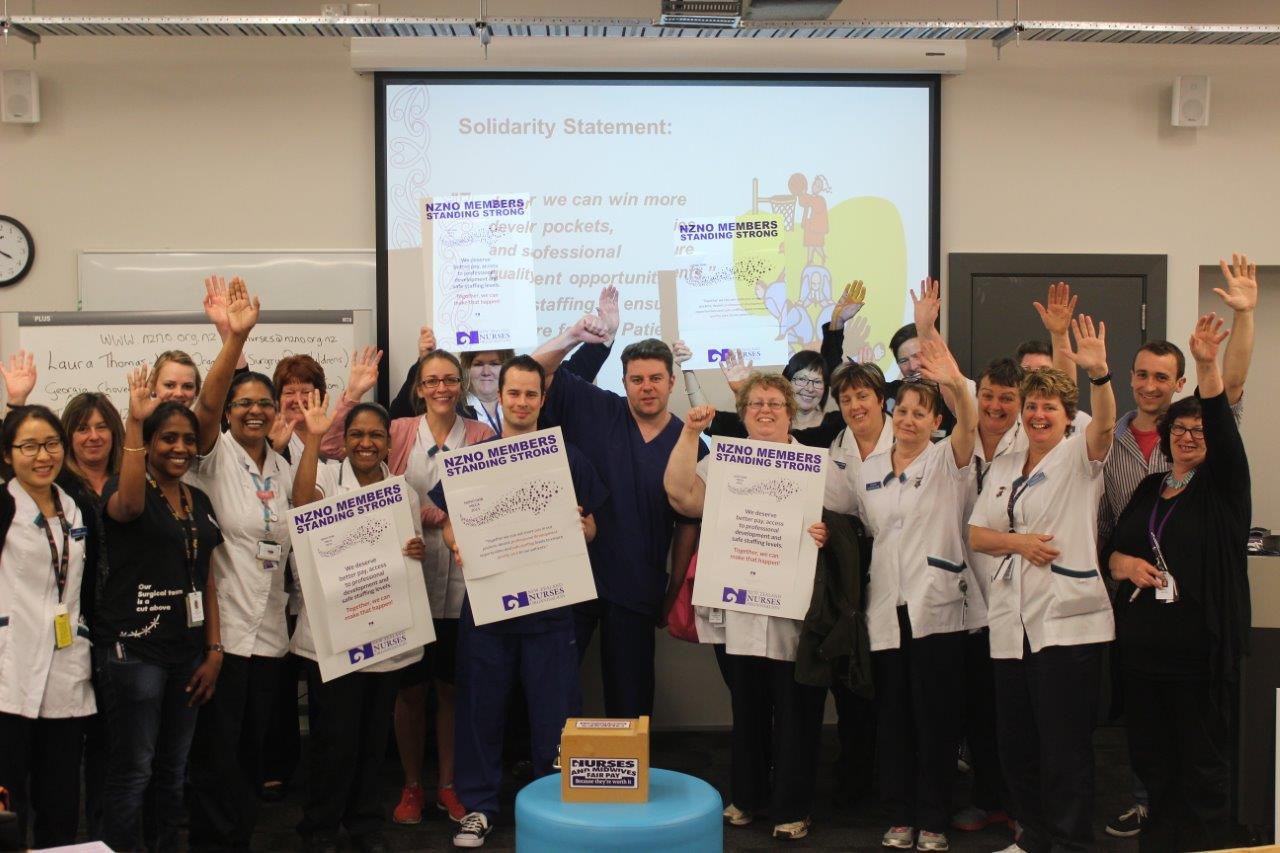
There you can show your support, like the Wellington Hospital members in the photo, for this solidarity statement:

“Together we can win more pay in our pockets, decent professional development opportunities and safe staffing to ensure quality care for our patients”.


1 Comment

Our health, our taonga

233_Hui_a_Tau233

Inspired attendees at the Indigenous Nurses Aotearoa conference 2014

Kerri Nuku is NZNO’s kaiwhakahaere and is of Ngāti Kahungunu descent. As a leader for Māori within NZNO she sees it as her responsibility to ensure that equity is achieved for all Te Rūnanga members.

The other day someone asked me what the highlight of my year has been so far. Usually that kind of question causes me to ponder for a while, but not this year. The absolute highlight of my year is the very first Indigenous Nurses Aotearoa conference, held in Tāmaki Makaurau in August.

The theme for the conference was “Our health, our taonga”, which really resonated with me – as I sense it did with every other attendee. We were stimulated and challenged in our collective responsibility to protect our fundamental right to good health and wellbeing.

It was so energising to be with over 250 indigenous nursing leaders, including nurses, midwives, nursing students, kaimahi hauora and health care assistants. Our combined enthusiasm and commitment to make sure health is a taonga was infectious. It is a privilege of our te ao Māori (Māori worldview) that we see health/hauora as a part of our whakapapa, our whanau, our environment and our culture.

As indigenous nursing professionals, we are committed to reaffirming our rights under the United Nations Declaration of Indigenous people’s article 3, to self determine, and this must underpin any future Māori nursing strategy. We must have faith in ourselves and be courageous in our aspirations for the health of our whānau, hapū and iwi. We must look towards the imagination place to see what could be.

We honour our early Māori nursing pioneers, like Te Akenehi Hei, who halted the death of Māori from introduced diseases. We have nothing to fear as we move into the future – our tipuna made sacrifices and we will too, so that our mokopuna, whānau, hapū and iwi receive the best health care available in Aotearoa.

As indigenous health professionals, we must have the freedom to determine what is best for us.

We will continue to advocate for Māori nursing and workforce issues. We will lobby for change and challenge the barriers that are placed in the way of Māori nursing and workforce success.

Kaimahi hauora:  be brave, take action when you can! Ko te kai ā te rangatira he kōrero!

No reira, tēnā koutou, tēnā koutou, tēnā tātou katoa.


Click here for more information about Te Rūnanga o Aotearoa, NZNO.


2 Comments

Value our elders by valuing us

2014-10-01 Day of the older person FB picToday is International Day of the Older Person; a day to celebrate the achievements and contributions that older people make to our society and tackle the barriers faced by older people.

American politician Hubert H. Humphrey was paraphrasing Ghandi when he said “…the moral test of government is how that government treats those who are in the dawn of life, the children; those who are in the twilight of life, the elderly; those who are in the shadows of life; the sick, the needy and the handicapped.

He’s right. And there’s plenty that NZNO members might want to say about that (check out NZNO’s priorities for health here), but let’s have a look at how we value our older citizens today.

The government approach to care of older people in Aotearoa is ageist. By under-funding this sector, the government is signaling that older people don’t matter. And by extension, neither do the workers who care for them. Staff in residential aged care facilities are some of the lowest paid workers in New Zealand, and successive governments, for over 20 years, have allowed that to continue.

In one of our many submissions to government we put it this way:

The high cost of providing substandard aged care is unsustainable and unjust: public health resources are unaccounted for; where there is a failure of care it is public health which ‘picks up the tag’ for care it has already paid for; services are being contracted out for care of our parents and grandparents with even less protection for their physical and mental wellbeing than for their financial wellbeing; public safety and our professional health workforce are being undermined: and an underclass of undervalued and underpaid workers is being embedded in our workforce while highly educated workers are leaving.”

That’s not valuing our elders or the people who care for them. We are failing to provide sufficient protection for the health, welfare and financial stability of either older people or those who work with them.

So, how do we change things? How can we show older people the respect and dignity they deserve?

Well, one way of doing that would be to value the people who care for them, and there’s a few ways of getting there…

Increase government funding to residential aged care providers; it’s just plain unfair that health care assistants and caregivers who work in aged care facilities get nowhere near as much as their colleagues who work in DHBs. The Government also needs to make sure that funding is passed on to workers, not retained as private sector profits.

A quality, nationwide training and education programme would achieve two things: consistently provided quality care for residents and a career pathway that would attract and retain great staff.

Regulate for safe staffing! Our members want to provide quality care, but at the same time as residents care needs increase, our members face continuous cuts to care hours. How can workers enjoy their work when they are stressed, overworkerd and worried about missing something and making a mistake? There must be enough staff to provide quality care for every resident.

None of this is rocket science, and none of it is news to the sector or the government. All that’s needed now is action! Action to value older New Zealanders and the people who care for them.

Our elders should be valued and celebrated. The workers who are carrying out the responsible and skilled work of caring for our elders should be valued, celebrated, admired and supported for their important work too.


Leave a comment

My journey, my patient’s journey

emotional-intelligenceHere’s another blog by West Coast mental health nurse Teniah Howell. This blog is cross-posted with permission  from the Nurses Station blog “The Tea Room”. You can read Teniah’s previous post here.

The topic of emotional intelligence has come up multiple times in my journey through nursing school and into the “real world” of nursing. When the topic was first mentioned to me, I had never heard of such a thing before, and really never considered the need to become competent in this area.

Emotional intelligence, essentially, is the ability to recognise your own feelings, emotions, and responses, as well as those of others. Now, we recognise these emotions in different ways – some people journal, some people simply contemplate, and others discuss with trusted mentors/supervision/work place support etc. The importance in understanding where we are at in our own lives allows us to more easily interpret the emotions and responses of the patients we work alongside. It is easier to help our patients find strategies for coping that work for them, if we have first acknowledged and recognised our own strengths and abilities to cope. Nurses cannot relate to patients and help them if they are themselves in an emotionally unstable place.

One thing that I have noticed in my own practice, is that in order to truly develop a therapeutic relationship with a patient, I must be able to differentiate between my own thoughts/emotions and the situation. I have to be able to know what I think and believe about myself and yet not push my own thoughts and beliefs onto my patient. I have to be able to recognise that my patient’s strengths and ways of coping will be different than my own. In my experience this ties into the idea that we all possess a “shared humanness”. While we share a lot of the same emotions, experiences, desires etc.; each one of us is unique and individual. While we all have different strengths and ways of coping with the challenges of life, we all still share the experience of being human. Therefore, we can offer each other grace, knowing that we are in many ways the same.

A patient’s journey can be made easier by having a nurse who will walk alongside them, who understands that human experience; a nurse who has her/himself faced challenges and experienced a range of emotions; a nurse who can relate to them, and also recognise their uniqueness. It takes an emotionally intelligent, competent nurse to do this. It takes someone who has explored their own thoughts and beliefs; someone who is not only able to recognise their own strengths, but can also recognise the individual strength of their patient.


3 Comments

Katrina Coleman – Young nurse of the year

DSC_0005The NZNO Young Nurse of the Year for 2014 is Katrina Coleman, 27, a Plunket nurse in Newtown, Wellington. She works with a large number of new migrant families, and helping improve their health outcomes is just as likely to see her advocating to move them to better housing, as assessing children’s growth and development. The communities have changed since Plunket began over a century ago, but Katrina’s work today in building trust with families, and connecting them with the people and services they and their children need to thrive has a lot in common with those first Plunket nurses. It draws on every bit of her nursing experience across mental health, hospital and public health.

Katrina has won the NZNO young nurse of the year award, but it’s clear the real winners are the new migrant families she works with in Newtown. She learned early on to adapt her schedule to their needs: “I do four to five home visits in the morning, and then four to five in the afternoon, and I remind everyone that I’m coming that morning. Often the people I’m seeing, their lives are so incredibly complex that even if I tell them the day before, they may forget.”

She acknowledges the high number of home visits is unusual for many communities: “It is a high amount of home visiting in Newtown – but it’s definitely the way to maintain engagement. If you imagine being a Somali mum with seven kids under 7, arranging transport to get to a Plunket clinic is just not able to be a high priority, because how could it be? It’s about making the service accessible and comfortable – arranging visits at their home, at a time they choose.”

Newtown is the most diverse community in Wellington, and one of New Zealand’s new migrant centres. Along with Somali families, Katrina works with families from Ethiopia, India, China, the Middle East – some New Zealand/European, and very few Maori and Pacific Islanders. For many, Katrina is often their only link: “We’ve seen women at the most vulnerable time of their life when they’re scared and sometimes they don’t have any real option but to trust you, because they don’t have anyone else.” You only have to imagine for a moment that you’re a newly arrived mum in Newtown, you don’t speak English, you can’t read or write, and you have no local connections, to get a small insight into the difficulties her clients face – and the significance of Katrina’s role.

Her work brings her into the homes of families living in appalling conditions, and a large part of her day is spent working with other agencies to get families’ basic needs met: “I remember sitting with a family last year who had been placed in a horrendous house, they had six kids under six. I was sat on the couch, and the mother said to me – ‘can you help me, there are rats living in my couch’ – the couch I was sitting on. You can imagine, I jumped pretty quickly. The situations people are living in, the poverty is appalling and often, these are people who don’t have a voice.”

She says some of the mums are illiterate: “They will ask me to fill in these forms for everything, not only for health services. It’s not in the role, but at the end of the day that’s why my relationship is strong – it’s about leaving my objectives of the visit at the door and doing what they need me to do, whether it’s filling in a form or looking for lice in people’s hair. It’s not always glamorous. It means having hard conversations with providers of social housing, but I refuse to back down when I’m advocating for a family.”

It goes beyond the Well Child schedule, but she does it because it’s a determining factor to a child being sick or well: “I can truly say there are families I visit now who would be sick every time I saw them, they’re now in insulated homes, they’ve access to kindy – and their overall health outcomes are improved.”

And it’s how she builds her relationship with a family – and the community. “I always knew when I started the role that it wasn’t just about building the relationship with families but with the broader community. In some cases, I’m the only NZ European person they know, or the only person who can link them in to the system.”

Which means maintaining boundaries can be a problem: “They say – can you stay and look after the kids I need to take this one to the doctors. Or can you drive my parent to the hospital. And I have to say no, and you can see this realisation – that we’re not friends, I’m doing a job. It’s an honour that people trust me with their parents and sick children, but it’s important I maintain those boundaries.”

Along with connecting families with services, she works to connect families with the people who have the resources and help they need. Not least, this means drawing on the Newtown Plunket committee of volunteers:  “We came up with the idea of Christmas parcels  – sunblock, beach towels, food and gifts. But the winter ones are the best, they have slippers, warm clothes, blankets and nutritious winter food – brand new and donated stuff. Newtown is an amazing place – we got $1000 of toys from the City Mission last year – just incredible generosity.”

And with the help of Plunket volunteers, she launched the Link database at the beginning of the year – a way for women of the same culture to be linked with each other. The idea started when one of her clients, a mum with two children under two, had come out of violent relationship but had no social support, spoke little English, and couldn’t leave the house as she had agoraphobia: “It was tragic – she was in an awful place. I knew another Chinese mum who was unhappy in her marriage, she was brought here soon after getting married, and she was living in huge apartment building, she knew no one, she had no transport. I wondered if it would be beneficial to link these two mums together. So I got consent, and over the next 6 months I saw the most incredible transformation in these women’s lives – the mum with agoraphobia was able to get out of the house. The other mum had a purpose to leave the house, and every time I see these families now you can see the change in these women, in how happy they are with their children and how connected they are in the community. I thought – this is totally the most amazing thing I’ve ever achieved.”

She says that sometimes it doesn’t work out because of social hierarchy, but the link database is now offered to all Wellington mums, and run by a Plunket volunteer.

Katrina is celebrating her 3-year anniversary as a Plunket nurse in Newtown this month and describes the community support system she’s helped set up as a ‘finely oiled machine’ – though is quick to acknowledge others: “I can’t take credit for the generosity of the people of Newtown. For example, the other day The Warehouse gave me 27 brand new winter jackets. They wanted to help – it’s amazing how many people will say yes when you ask. And five years before I stared, Jess, the Plunket nurse here laid a huge foundation – she built a lot of that trust building in the community – I picked up on her vision and her dream for Newtown. It’s a great place.”

“I came from public health nursing from Waikato – it’s so isolated there, getting to hospital appointments is a nightmare. Here we’re right in the thick of it. If you’ve got a hospital appointment – you can walk there.”

Her enthusiasm isn’t worn by the challenges – instead, it’s clear she loves the job, and thrives on helping the people she works with: “There’s a huge aspect of social work involved in it. Possibly some of the nurses before me would have said ‘this isn’t my job’. I truly believe I have a working relationship with the migrant families – I decided I was going to be “that” person. It’s about triaging the need, meeting their needs one by one.”

She acknowledges it’s an intense role, and has worked out tactics for conserving her energy – like not looking too far ahead: “I never look at what my next day is going to look like until I get there because of how big they’ll be – I don’t want to start the day feeling exhausted by the day’s work I’m about to do.”

But while she takes each day at a time, when she decided to work for Plunket, she took the long view: “I always saw the role with Plunket as a long-term commitment – it’s not like working with the hospital when you have short-term, intense relationships of trust. It takes years to become trusted with in the community and when you take on a role with Plunket, you’re aware that you’re going to invest the time with the community as well as the families.”

“I always wanted to be a Plunket nurse – I was sitting in class and remember the Plunket nurse coming in working with well children in the community – I wanted to gain as much experience as I could and I’d recommend that to all new nurses. I worked in mental health and did my first post grad certificate in mental health – it’s priceless in this role, dealing with mums who are struggling with their mental health and have been through so much.”

As for the future, she’s a year away from completing her masters in nursing: “I don’t know where I’ll go next, but I can’t imagine not being in Newtown.  I’m from Hutt Valley originally and I’ve lived on the coast for seven or eight years –I think it helps being so far away. It would be hard to do this job while living in Newtown.”

And news of the award itself still hasn’t sunk in: “I think everyone’s blown away – it’s such an honour. My friends and family are my number one support. They always think you’re the best of the best anyway, but it’s hugely pride evoking.   The award is nice because it makes missing out on family functions and catching up with friends only occasionally all for something.”

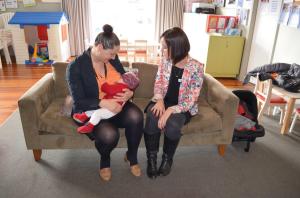
The photo shows Plunket nurse Katrina Coleman with Rebecca Brown and her 12 week old daughter, Juniper Johnson. Thanks to Rebecca for allowing us to use this wonderful photo.



Leave a comment

What do you want for your life?

2014.09.08_NZNO_LaunchBlogPost_imageNowadays, more and more New Zealand workers are seeking work / life balance.  Kai Tiaki previously reported the findings of research conducted by the New Zealand Department of Labour which indicated that 40 percent of respondents had experienced difficulties achieving an acceptable level of work / life balance.  Significantly, it found that nurses were amongst the workers experiencing the most difficulty in getting the balance right.

With this in mind, NZNO recently teamed up with Member Advantage to review its member benefits program.  In addition to the NZNO negotiated benefits you’ve already enjoyed, Member Advantage brings you a host of great benefits designed to make your life a little easier and a lot more enjoyable including:

  • Great discounts on hotels worldwide
  • Attractive corporate rates on car rental
  • Competitive foreign exchange rates across 47 currencies and fee-free transfers
  • Savings on over 4,500 experiences and gifts

Click here and log in using your NZNO membership number to discover the benefits available to you.